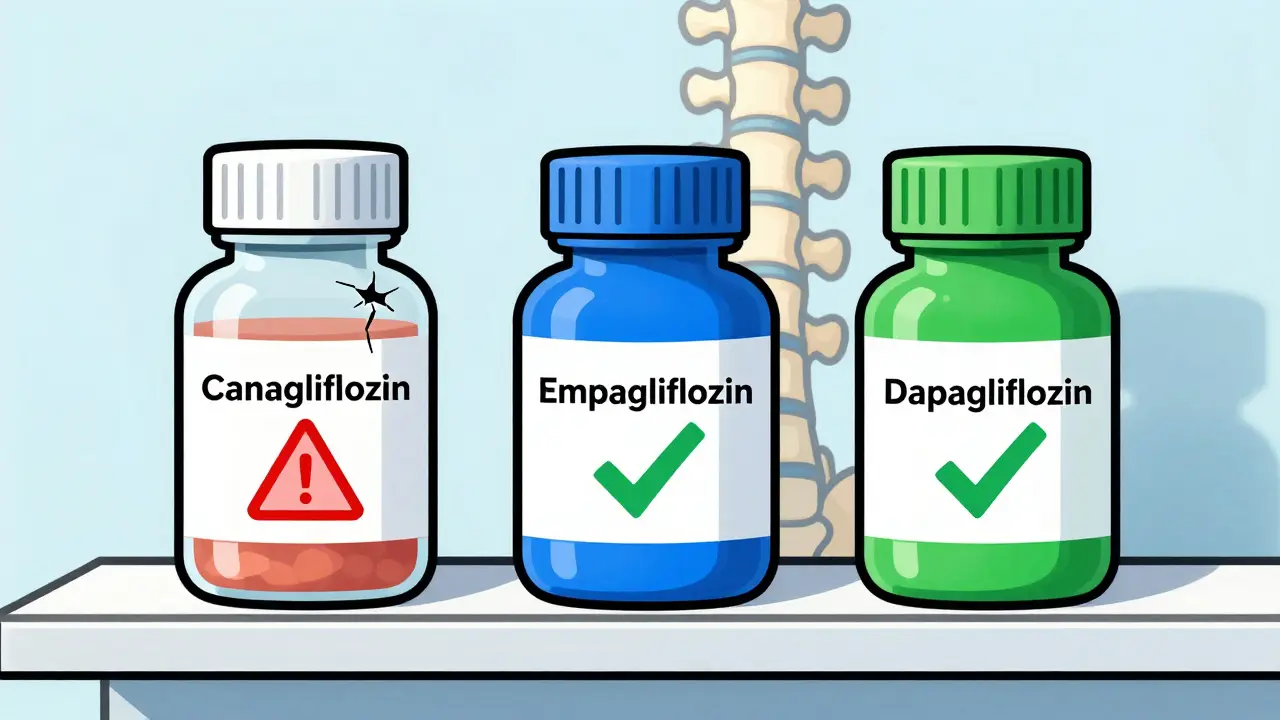
SGLT2 Inhibitor Fracture Risk Comparator
Canagliflozin
(Invokana)
High CautionFDA Warning Active
Empagliflozin
(Jardiance)
Low/StandardNo Specific Warning
Dapagliflozin
(Farxiga)
Low/StandardNo Specific Warning
Select a medication above to view detailed risk analysis.
You take your morning pill for type 2 diabetes. It helps protect your heart and kidneys, lowers your blood sugar, and maybe even helps you lose a few pounds. But have you ever wondered if that same pill is quietly weakening your bones? For years, headlines warned that SGLT2 inhibitors are a class of diabetes medications that lower blood glucose by blocking reabsorption in the kidneys might increase your risk of breaking a bone. If you’re an older adult with osteoporosis, or if you’ve fallen before, this isn’t just academic-it’s personal.
The short answer? It depends on which drug you take. The fear wasn’t baseless, but it was also overly broad. Recent data shows that not all SGLT2 inhibitors affect bones the same way. One specific drug carries a warning; the others generally do not. Understanding this difference can help you and your doctor choose the safest path forward without sacrificing the cardiovascular benefits these drugs provide.
The Origin of the Fear: Why We Started Worrying About Bones
To understand where we stand today, we have to look back at 2015. That’s when the U.S. Food and Drug Administration (FDA) issued its first safety communication regarding Invokana, the brand name for canagliflozin is an SGLT2 inhibitor approved in March 2013 that was linked to increased fracture risks in early trials. The concern stemmed from the CANVAS trial, a massive study involving over 10,000 patients. Researchers noticed that people taking canagliflozin had more fractures than those on a placebo.
At the time, the medical community hit the panic button. The FDA updated the label to include a warning about bone fractures occurring as early as 12 weeks after starting treatment. These weren’t major car-accident breaks; they were often minor falls-like tripping on a rug-that resulted in broken hips or wrists because the bones were less dense. This created a ripple effect. Doctors became hesitant to prescribe any drug in the SGLT2 class, worried that the risk applied to everyone.
But here is the nuance that got lost in the noise: the signal was strongest with canagliflozin, specifically at the higher 300 mg dose. Other drugs in the same family, like empagliflozin and dapagliflozin, did not show the same clear pattern in their initial large-scale studies. Yet, the stigma stuck. For nearly a decade, "SGLT2 inhibitor" and "fracture risk" were treated as synonymous phrases in many clinical discussions.
How Do These Drugs Affect Your Skeleton?
If you’re wondering how a sugar-lowering pill affects your skeleton, the mechanisms are complex and still being fully mapped out. It’s not one single factor, but a combination of physiological changes triggered by the medication.
- Weight Loss: SGLT2 inhibitors typically cause a weight loss of 2-4 kg. While losing weight is good for your joints, rapid weight loss can sometimes correlate with markers of bone resorption (breakdown). However, research from the NIH suggests weight loss explains only about 3% of the variance in bone breakdown markers, meaning other factors are at play.
- Fluid and Electrolyte Shifts: These drugs make you pee out more glucose, which pulls water and minerals with it. There is evidence that SGLT2 inhibitors increase urinary phosphate excretion. Phosphate is crucial for bone strength. When you lose too much, your body may trigger hormonal responses involving parathyroid hormone (PTH) and fibroblast growth factor 23 (FGF23), which can theoretically weaken bone structure over time.
- Hormonal Changes: Some studies noted that women taking high-dose canagliflozin experienced a slight drop in estradiol levels (about 9.2%). Estrogen is vital for maintaining bone density in post-menopausal women, so even small shifts matter.
- Fall Risk: Perhaps the most immediate danger isn’t weak bones, but falling. SGLT2 inhibitors can cause postural hypotension is a sudden drop in blood pressure when standing up, causing dizziness. This occurs in roughly 0.4% to 1.0% of patients. If you get dizzy and fall, the condition of your bones determines whether you walk away with a bruise or a break.
It’s important to separate correlation from causation. People with long-standing type 2 diabetes already have compromised bone health due to inflammation and poor glycemic control. Disentangling the drug’s effect from the disease’s effect has been a challenge for researchers.
Not All SGLT2 Inhibitors Are Created Equal
This is the most critical takeaway for anyone managing their diabetes care: the class-wide assumption of risk is outdated. Current evidence strongly differentiates between the agents within this class.
| Medication (Brand) | Clinical Trial Data | Current FDA Warning Status | Prescribing Caution Level |
|---|---|---|---|
| Canagliflozin (Invokana) | CANVAS trial showed HR 1.26 for fractures | Yes: Warning & Precaution for fractures | High (especially >65 yrs or osteoporosis) |
| Empagliflozin (Jardiance) | EMPA-REG OUTCOME showed no significant increase | No specific fracture warning | Low/Standard |
| Dapagliflozin (Farxiga) | DECLARE-TIMI 58 showed no significant increase | No specific fracture warning | Low/Standard |
In the EMPA-REG OUTCOME trial for empagliflozin and the DECLARE-TIMI 58 trial for dapagliflozin, fracture rates were statistically similar to placebo groups. A comprehensive meta-analysis published in January 2023 in HIV/NATAP, combining data from 27 randomized controlled trials with nearly 21,000 participants, found a pooled relative risk of 1.02 for fractures across SGLT2 inhibitors. In statistical terms, 1.02 is essentially zero risk difference. The confidence interval included 1.0, indicating no meaningful correlation between the drug class and higher fracture risk overall.
However, the FDA maintains its specific warning for canagliflozin. Why? Because the signal there was consistent enough to warrant caution, particularly in vulnerable populations. The European Medicines Agency (EMA) takes a slightly broader view, requiring class-wide warnings about potential bone effects, but U.S. guidelines are more precise.
What Do the Experts Say Now?
The consensus among endocrinologists and bone health specialists has shifted dramatically since 2015. Dr. Mary Buettner and Dr. Thomas Addison, authors of a pivotal 2023 study in the Journal of Parathyroid Disease, analyzed real-world evidence and concluded that there is no connection between using SGLT2 inhibitors and fracture risk in the general population. They stated clearly that these findings should alleviate concerns for clinicians treating type 2 diabetes.
Yet, caution remains for specific subgroups. Dr. Robert Heaney, a renowned bone metabolism expert, cautioned in Endocrine Reviews that early trials might have had statistical biases due to low fracture numbers, suggesting longer follow-up is needed. More practically, the American Association of Clinical Endocrinologists (AACE) recommends assessing bone mineral density (BMD) before starting canagliflozin in patients who already have osteoporosis or a history of fractures. They do not extend this strict requirement to empagliflozin or dapagliflozin.
In clinical practice, this plays out in prescribing habits. A 2022 survey by the Endocrine Society found that 82% of endocrinologists avoid canagliflozin in patients with osteoporosis (defined as a T-score ≤ -2.5). In contrast, only 34% express similar caution with dapagliflozin. This reflects a nuanced approach: don’t throw out the baby with the bathwater, but be careful with the specific agent that raised the red flag.

Practical Steps for Patients and Providers
If you are considering an SGLT2 inhibitor, or are already taking one, here is how to manage your bone health proactively. You don’t need to live in fear, but you do need to be informed.
- Know Your Baseline: If you are over 65, have had a previous fracture, or have a family history of osteoporosis, ask for a DXA scan (dual-energy X-ray absorptiometry). This measures your bone mineral density. Knowing your T-score gives you a baseline to track changes.
- Discuss Fall Prevention: Since dizziness can lead to falls, rise slowly from sitting or lying positions. Stay hydrated, especially when starting the medication. Review other medications that might increase dizziness or interact with your diabetes drug.
- Optimize Nutrition: Ensure adequate intake of calcium and Vitamin D. SGLT2 inhibitors increase urinary phosphate loss, so maintaining strong dietary sources of phosphorus (like dairy, nuts, and legumes) alongside calcium supports bone remodeling.
- Choose the Right Agent: If you have established osteoporosis, discuss empagliflozin or dapagliflozin with your doctor. They offer similar cardiovascular and renal benefits without the specific fracture warning associated with canagliflozin. The American Geriatrics Society’s Beers Criteria lists canagliflozin as potentially inappropriate for older adults with osteoporosis, but not the others.
- Monitor Regularly: If you start canagliflozin despite risk factors, schedule periodic bone density checks. Report any unexplained bone pain or minor injuries to your provider immediately.
Remember, the benefits of SGLT2 inhibitors in preventing heart failure and slowing kidney disease progression are well-established and life-saving for many. The goal is not to avoid these drugs entirely, but to use them intelligently. For most patients, the cardiovascular protection far outweighs the minimal or non-existent fracture risk.
The Bottom Line on Bone Safety
The narrative around SGLT2 inhibitors and bone health has evolved from alarm to clarity. The initial fears were driven by data from one specific drug, canagliflozin, which does carry a modestly increased risk of fractures, particularly in older adults and those with pre-existing bone weakness. However, the rest of the class-empagliflozin and dapagliflozin-has demonstrated a safe profile regarding bone integrity in large, rigorous trials.
For the average patient with type 2 diabetes, the risk of a fracture from these medications is negligible compared to the substantial benefits of reduced hospitalizations for heart failure and slower decline of kidney function. If you are at high risk for osteoporosis, you have options. Switching to a different SGLT2 inhibitor allows you to keep the metabolic and organ-protective advantages while minimizing skeletal concerns.
Always talk to your healthcare provider about your individual risk profile. Don’t let outdated headlines stop you from accessing effective care, but do advocate for a personalized plan that considers your entire health picture, from your heart to your hips.
Do all SGLT2 inhibitors increase the risk of bone fractures?
No. Current evidence indicates that only canagliflozin has a consistent association with increased fracture risk, particularly in older adults. Empagliflozin and dapagliflozin have not shown a significant increase in fracture risk in major clinical trials.
Which SGLT2 inhibitor is safest for someone with osteoporosis?
Empagliflozin (Jardiance) and dapagliflozin (Farxiga) are generally considered safer options for patients with osteoporosis or a history of fractures, as they lack the specific FDA warning for bone fractures that applies to canagliflozin.
Why does canagliflozin have a fracture warning?
The CANVAS clinical trial showed a statistically significant increase in fracture rates for patients taking canagliflozin compared to placebo. The FDA determined this risk was sufficient to require a warning, especially for doses of 300 mg and in high-risk populations.
Can SGLT2 inhibitors cause dizziness and falls?
Yes, all SGLT2 inhibitors can cause postural hypotension (a drop in blood pressure when standing), which may lead to dizziness and falls. This is a mechanical risk factor for fractures regardless of bone density. Staying hydrated and rising slowly can mitigate this risk.
Should I stop taking my SGLT2 inhibitor if I am worried about bones?
Do not stop your medication without consulting your doctor. The cardiovascular and renal benefits of SGLT2 inhibitors are significant. If you are concerned, your doctor may switch you to a different agent in the same class with a better bone safety profile rather than stopping therapy entirely.
Does weight loss from SGLT2 inhibitors harm bone health?
While rapid weight loss can be associated with some bone resorption markers, studies suggest weight loss accounts for only a small portion (approx. 3%) of bone changes. The direct pharmacological effects on phosphate and hormones are likely more significant contributors to any potential bone impact.