

Antibiotic Sun Exposure Risk Calculator
Sun Safety Calculator
Based on your antibiotic and exposure time, we'll calculate your risk level and provide specific sun protection recommendations.
Your Sun Exposure Risk Assessment
When you’re prescribed doxycycline or TMP-SMX (Bactrim, Septra), your doctor focuses on fighting the infection. But there’s another, often overlooked side effect that can turn a sunny day into a painful mistake: photosensitivity. This isn’t just about getting a little tan-it’s about your skin reacting badly to sunlight in ways that can cause severe burns, rashes, and even long-term damage. If you’re taking one of these antibiotics, you need to know exactly how to protect yourself, because the risk is real, and it’s higher than most people realize.
What Exactly Is Antibiotic-Induced Photosensitivity?
Photosensitivity means your skin becomes overly sensitive to ultraviolet (UV) light because of a medication. With doxycycline and TMP-SMX, this isn’t a rare side effect-it’s common. About 20% of people taking doxycycline at standard doses (200 mg daily) will develop a phototoxic reaction. That’s one in five. For TMP-SMX, the risk is slightly lower but still significant, and the reaction can linger for weeks after you stop taking it. There are two types of reactions. The most common-making up about 95% of cases-is phototoxic. It looks like a bad sunburn. Redness, pain, blistering, peeling-all show up within 30 minutes to 24 hours of being in the sun. The second type, photoallergic, is rarer. It triggers an immune response, causing an itchy, eczema-like rash that shows up 24 to 72 hours later. Both are preventable. Neither should be ignored.Why Doxycycline and TMP-SMX Are High-Risk
Not all antibiotics cause this. Penicillin? Minimal risk. But doxycycline and TMP-SMX are in the top tier of offenders. Why? Doxycycline, a tetracycline-class antibiotic, absorbs UVA light (320-400 nm). That’s the type of UV that passes through windows and clouds. So even if you’re sitting by a sunny window indoors, you’re not safe. Once absorbed, the drug triggers chemical reactions in your skin that damage cells, leading to inflammation and burns. Studies show that patients taking 600 mg/day of demeclocycline-a close relative of doxycycline-had phototoxic reactions in nearly all cases. Doxycycline is less extreme, but still dangerous at standard doses. TMP-SMX (trimethoprim-sulfamethoxazole) works differently. Its sulfamethoxazole component is the main culprit. It doesn’t just affect UVA-it can react to a broader range of UV wavelengths. The result? Skin reactions can happen after very brief sun exposure. And unlike doxycycline, where the risk fades within days of stopping the drug, TMP-SMX can keep your skin vulnerable for weeks after your last pill. One patient reported a severe burn two weeks after finishing a 10-day course of Bactrim.How Bad Can It Get?
The damage isn’t just uncomfortable-it’s serious. Your skin’s minimum erythema dose (MED)-the smallest amount of UV needed to cause redness-can drop by up to 50% while you’re on these drugs. That means you burn twice as fast. A 10-minute walk to the mailbox could leave you blistered. In one study, 27 out of 108 patients taking demeclocycline developed sunburns during treatment. All resolved after stopping the drug, but the pain and scarring were real. Dermatologists now see a 15% yearly increase in photosensitivity cases since 2018, partly because antibiotics like doxycycline are being prescribed more often-for acne, Lyme disease, respiratory infections-instead of older, safer options. Long-term, repeated sunburns from these drugs raise your risk of skin cancer. The Skin Cancer Foundation explicitly links drug-induced photosensitivity to increased melanoma and non-melanoma skin cancer risk. This isn’t hypothetical. It’s a documented consequence.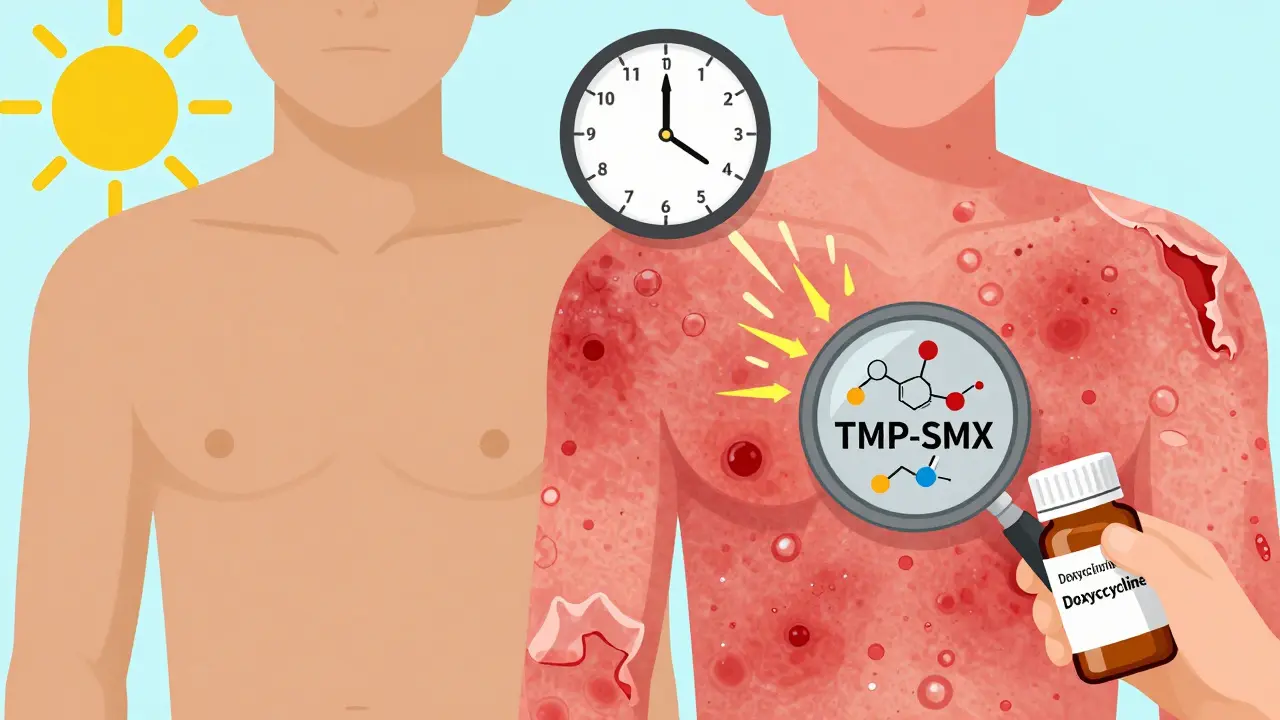
What You Must Do to Stay Safe
If you’re on doxycycline or TMP-SMX, sun protection isn’t optional. It’s non-negotiable. Here’s what works:- Use broad-spectrum SPF 30+ sunscreen every day-even when it’s cloudy. Reapply every two hours, or after sweating or swimming. Don’t forget ears, neck, lips, and the tops of your feet.
- Avoid direct sun between 10 a.m. and 4 p.m. That’s when UV rays are strongest. Plan outdoor tasks for early morning or late afternoon.
- Wear protective clothing. A regular cotton T-shirt only blocks about UPF 5. You need UPF 30+ sun-protective fabric. Long sleeves, pants, and a wide-brimmed hat are essential. Look for clothing labeled “UV protective” at outdoor stores.
- Protect yourself indoors. UVA rays pass through glass. If you sit near a window at home or in the car, you’re still exposed. Use window films or keep blinds closed during peak hours.
- Stay protected after finishing the course. For TMP-SMX, continue sun safety for at least two weeks after your last dose. For doxycycline, keep it up for 3-5 days after stopping.
What Doesn’t Work
Many people think a little sunscreen or staying in the shade is enough. It’s not. Standard clothing offers almost no protection. Umbrellas block direct sun but not scattered UV rays. Tanning beds? Absolutely off-limits. Even LED or fluorescent lights won’t trigger a reaction, but don’t assume you’re safe just because you’re indoors. Also, don’t rely on memory. Patients in studies show that 40% stop using sun protection within the first week of treatment because they think they’re “fine.” That’s when the worst burns happen.What Your Doctor Should Tell You
Too often, photosensitivity isn’t mentioned during prescription counseling. One survey found that nearly half of patients weren’t warned about sun risks with antibiotics. That’s unacceptable. Your doctor should clearly say: “This medicine makes you burn easily. You need to avoid sun and use sunscreen every day.” If they don’t, ask. Say: “I’ve heard this antibiotic can make me sensitive to the sun. What do I need to do?” If they brush it off, get a second opinion. This isn’t a minor side effect-it’s a safety issue.
What to Do If You Get Burned
If you notice redness, pain, or blistering after sun exposure while on these antibiotics:- Get out of the sun immediately.
- Cool the area with a damp cloth or lukewarm bath.
- Apply a fragrance-free moisturizer or aloe vera gel.
- Take an over-the-counter pain reliever like ibuprofen if needed.
- Don’t pop blisters-they protect healing skin.
- Contact your doctor if the burn is severe, covers a large area, or doesn’t improve in a few days.
Alternatives? Maybe.
If you’re prone to sunburns or spend a lot of time outdoors, talk to your doctor about alternatives. For some infections, azithromycin or amoxicillin may be options with lower photosensitivity risk. But not all infections respond to these. Doxycycline is often the best or only choice for Lyme disease, acne, or certain respiratory infections. The goal isn’t always to switch drugs-it’s to manage the risk safely.Bottom Line: Sun Safety Is Part of Your Treatment
Taking doxycycline or TMP-SMX doesn’t mean you have to stay inside. But it does mean you need to treat sun exposure like a medical risk-just like avoiding alcohol with certain meds. Protect your skin like you protect your health: consistently, deliberately, and without compromise. The sun isn’t your enemy. But when you’re on these antibiotics, it becomes one. Don’t let a simple infection turn into weeks of pain and damage. Use sunscreen. Cover up. Stay smart. Your skin will thank you.Can I still go outside if I’m taking doxycycline?
Yes, but you must protect yourself. Avoid direct sun between 10 a.m. and 4 p.m., wear UPF 30+ clothing, and reapply broad-spectrum SPF 30+ sunscreen every two hours. Even sitting near a window can trigger a reaction because UVA rays pass through glass.
How long does sun sensitivity last after stopping TMP-SMX?
For TMP-SMX (Bactrim), sun sensitivity can last for up to two weeks after your last dose. Unlike doxycycline, where the risk fades within days, the sulfamethoxazole component stays in your system longer and continues to react with UV light. Continue strict sun protection for at least 14 days after finishing the course.
Is SPF 15 enough if I’m on antibiotics?
No. SPF 15 blocks about 93% of UVB rays, but it’s not enough when you’re photosensitive. Use SPF 30 or higher, and make sure it’s broad-spectrum (protects against both UVA and UVB). Studies show that people on doxycycline or TMP-SMX burn at much lower UV doses, so you need maximum protection.
Can I use tanning beds while taking these antibiotics?
Absolutely not. Tanning beds emit concentrated UVA and UVB radiation, which will trigger severe phototoxic reactions if you’re on doxycycline or TMP-SMX. This isn’t just a risk-it’s a guaranteed injury. Avoid all artificial UV sources while taking these drugs and for at least two weeks after.
Do all antibiotics cause sun sensitivity?
No. Penicillins, cephalosporins, and macrolides like azithromycin have very low risk. But tetracyclines (doxycycline, minocycline) and sulfonamides (TMP-SMX) are among the highest-risk antibiotics. Always ask your pharmacist or doctor if your specific antibiotic causes photosensitivity.
Should I stop taking the antibiotic if I get a sunburn?
Don’t stop without talking to your doctor. Stopping antibiotics early can lead to antibiotic resistance or a return of the infection. Instead, focus on sun protection and treat the burn. Your doctor may adjust your treatment plan, but never discontinue the medication on your own.

Comments
I got burned so bad on doxycycline last summer I thought I’d lost a bet with the sun. Thought I was being careful-sunscreen, hat, the whole thing. Didn’t realize UVA goes through windows. Sat by my kitchen window reading and came out looking like a lobster. Never again. Now I treat sunscreen like brushing my teeth-morning and night, rain or shine.
Also, I started wearing those UV-protective shirts from REI. They’re pricey but worth every penny. My skin hasn’t flared up since.
Doctors need to stop treating this like a footnote. It’s not ‘maybe’-it’s ‘you will burn’.
Respectfully, as someone from India where sun exposure is part of daily life, this is not just a Western concern. We have millions on doxycycline for acne and infections, and no one warns them. I saw a neighbor get second-degree burns from walking to the market at 8 a.m. He thought ‘early’ meant safe. It doesn’t. This guide should be translated into Hindi and distributed at every pharmacy.
Also, SPF 30+ is non-negotiable. Even if you’re used to the sun, this is different. It’s chemical, not natural.
just started doxycycline for my acne and i didnt even know this was a thing
now im wearing a hoodie indoors
also why does no one talk about this
its funny how we think of medicine as this pure thing that fixes us but forgets that our bodies are made of light and chemistry and the two dont always play nice
doxycycline absorbs uva like a sponge and then turns our skin into a canvas for pain
we dont need more warnings we need more awareness that our bodies are not machines
and yes i know i spelled some words wrong im thinking too hard
Just wanted to say this is one of the most practical, non-dramatic guides I’ve read on this. I’m on TMP-SMX right now and honestly, I’d have blown off the sun advice if I hadn’t seen this. The part about UVA through windows? That’s the kicker. I never thought about sitting by my desk near the window. Now I’ve got a sun-blocking film on it. Small change, huge difference.
Also, the 2-week post-course warning for TMP-SMX? That’s the detail that saves people. Most don’t realize it lingers.
Oh wow, so Americans are now too delicate to walk outside without a full hazmat suit? We used to just get a tan and deal with it. Now you need UPF 30 clothing, UV-blocking film, and a 10-step sunscreen ritual just to go to the mailbox?
Maybe the real problem is that you’re all pale as ghosts and never built up a tolerance. Try spending 10 minutes in the sun without sunscreen for once. Your skin might learn to not be a baby.
So I got burned on doxycycline last year and thought I was just unlucky… until I read this and realized I’m not the only one who’s been gaslit by doctors.
My dermatologist said ‘it’s rare’ and my GP said ‘just use SPF 15’-both wrong. I now carry a small UV meter in my purse. Yes, I’m that person. But I’ve had zero reactions since.
Also, the part about TMP-SMX lingering for weeks? That’s the silent killer. My aunt got burned two weeks after finishing her course. She thought she was ‘safe’ because she wasn’t ‘on it anymore.’
Doctors: stop being lazy. This isn’t a footnote. It’s a medical duty.
Let’s be honest: this is just another example of medical overcaution disguised as education. Photosensitivity reactions are statistically rare in absolute terms, yet this article reads like a doomsday pamphlet.
Are there risks? Yes. But the fearmongering around sunscreen dependency and UV-blocking films is disproportionate. People are being conditioned to fear the sun, which has known health benefits-including vitamin D synthesis and circadian regulation.
Also, the claim that ‘repeated sunburns raise melanoma risk’ is oversimplified. The correlation is weak when controlling for genetic predisposition and intermittent exposure patterns.
Before we turn every antibiotic user into a hermit, let’s see the actual incidence data-not anecdotal burn stories.