

Medication errors still kill and harm millions of people every year. But in 2025, the tide is turning. Major health organizations released a wave of new medication safety guidelines that are reshaping how pharmacies, hospitals, and national health systems operate. These aren't just minor tweaks; they are structural changes designed to stop preventable mistakes before they reach the patient.
If you work in healthcare or manage a pharmacy, these updates affect your daily workflow, staffing, and budget. If you are a patient, they mean stricter checks on your prescriptions. Let's break down exactly what changed, why it matters, and how to navigate the new landscape without getting overwhelmed by compliance paperwork.
The Big Picture: Who Updated What?
Several key players moved simultaneously in 2025, creating a unified push toward safer drug administration. It’s not just one agency acting alone; it’s a coordinated effort across global and local levels.
- Institute for Safe Medication Practices (ISMP) launched its 2025-2026 Targeted Medication Safety Best Practices for Community Pharmacy in March 2025. This is the fourth biennial update since 2014, focusing specifically on community settings where many fatal errors occur despite repeated warnings.
- World Health Organization (WHO) published a comprehensive guideline on balanced national controlled medicines policies in September 2025. This replaces the 2011 guidance and aims to ensure access to essential drugs while minimizing misuse, targeting a 50% reduction in serious, preventable medication harm globally within five years.
- National Institute for Occupational Safety and Health (NIOSH) updated its List of Hazardous Drugs in Healthcare Settings in December 2024, with critical additions in July 2025. This list dictates how staff must handle dangerous chemicals, particularly in oncology.
- Centers for Medicare & Medicaid Services (CMS) implemented 16 Patient Safety measures for measurement year 2025. These metrics directly impact Medicare Part D plan Star Ratings, linking safety performance to financial viability for insurance plans.
Key Changes in Community Pharmacy Operations
For community pharmacists, the ISMP 2025-2026 guidelines are the most immediately actionable. The framework identifies six specific areas requiring greater action to reduce errors:
- Weight-Based Verification: Using patient weight to verify dosing of weight-based medications. One Texas pharmacy chain reported a 63% reduction in pediatric dosing errors after implementing this protocol, though it required significant staff retraining.
- Return-to-Stock Technology: Implementing technology to prevent errors during return-to-stock processes, a common source of mix-ups.
- High-Alert Double Checks: Verifying high-alert medications through independent double checks to catch critical mistakes.
- Standardized IV Concentrations: Standardizing concentrations of commonly used IV medications to reduce calculation errors.
- Barcode Scanning: Implementing barcode scanning for all medication administrations. While hospital adoption is at 89%, community pharmacy adoption lags at 37% due to cost constraints.
- Critical Test Communication: Establishing standardized protocols for communicating critical test results to patients and providers.
Dr. Michael Gaunt, senior manager of Error Reporting Programs at ISMP, emphasized that these are "realistic and practical strategies." He advises pharmacies to assess their current implementation status and plan phased rollouts rather than trying to do everything at once.
Hazardous Drug Handling: New Additions to Watch
The NIOSH List of Hazardous Drugs underwent significant expansion. In December 2024, 25 drugs were added to the 2016 list, with three more added on July 17, 2025: datopotamab deruxtecan (Datroway®), treosulfan (Grafapex™), and telisotuzumab vedotin (Emrelis™). All three are antineoplastic agents, reflecting emerging evidence of occupational risks for staff handling novel antibody-drug conjugates.
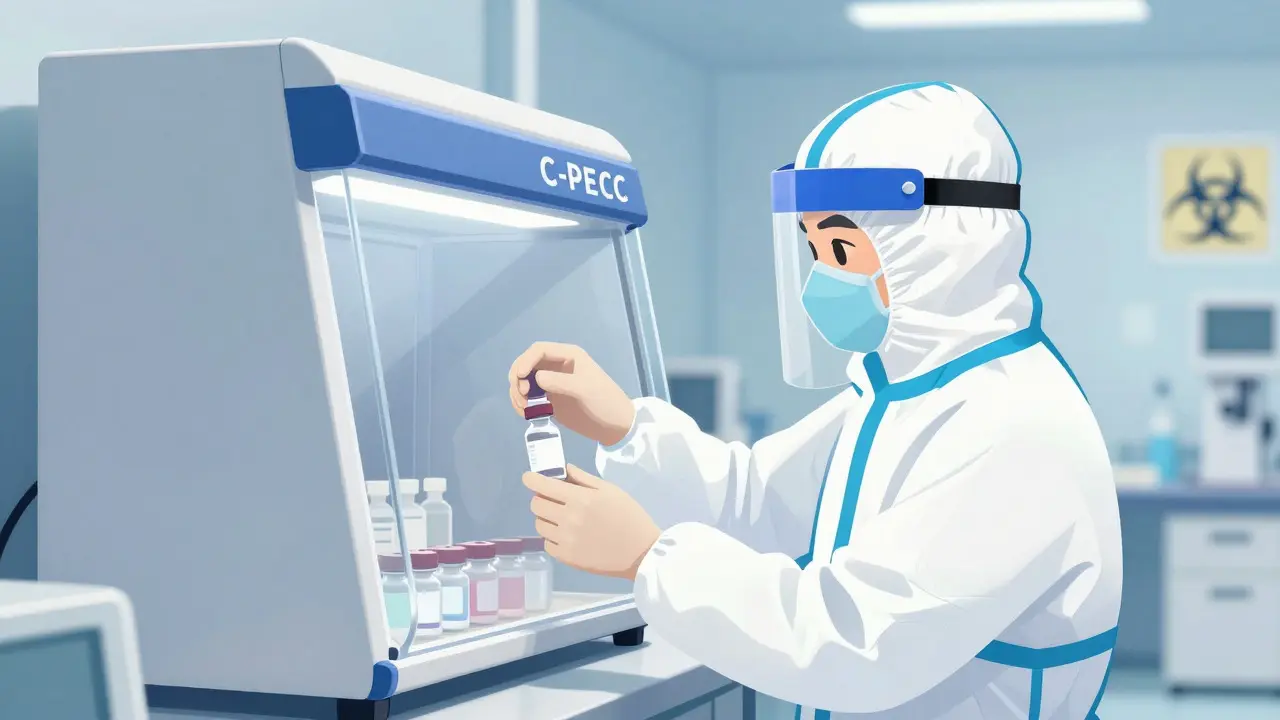
This isn't just bureaucratic listing. It triggers specific engineering controls. Pharmacies now need containment primary engineering controls (C-PECs) for preparation and compounding. Based on the 2025 NCPA Economic and Technology Survey, implementation costs range from $15,000 to $50,000 per pharmacy. Hospital pharmacists have noted that mid-fiscal-year updates created workflow challenges, but early adopters report preventing potential exposure incidents.
Financial Implications: CMS Star Ratings and Adherence
Safety isn't just about clinical outcomes anymore; it's tied to money. CMS's 2025 Patient Safety measures include transitioning remaining Part D measures to continuous enrollment methodology. Key metrics like Medication Adherence for Cholesterol (Statins) (ADH-Statins) and Use of Opioids at High Dosage in Persons without Cancer (OHD) directly influence Star Ratings.
These ratings determine plan enrollment and reimbursement. To achieve an 80%+ adherence rate for statins, plans are implementing automated refill reminders, medication synchronization programs, and targeted clinical interventions. For independent pharmacies, integrating these tracking systems into pharmacy management software averages $8,200 per location, according to the August 2025 NCPA QAM report. It’s a heavy lift, but failing to meet these benchmarks can jeopardize contract renewals.
Global Context: The WHO Framework
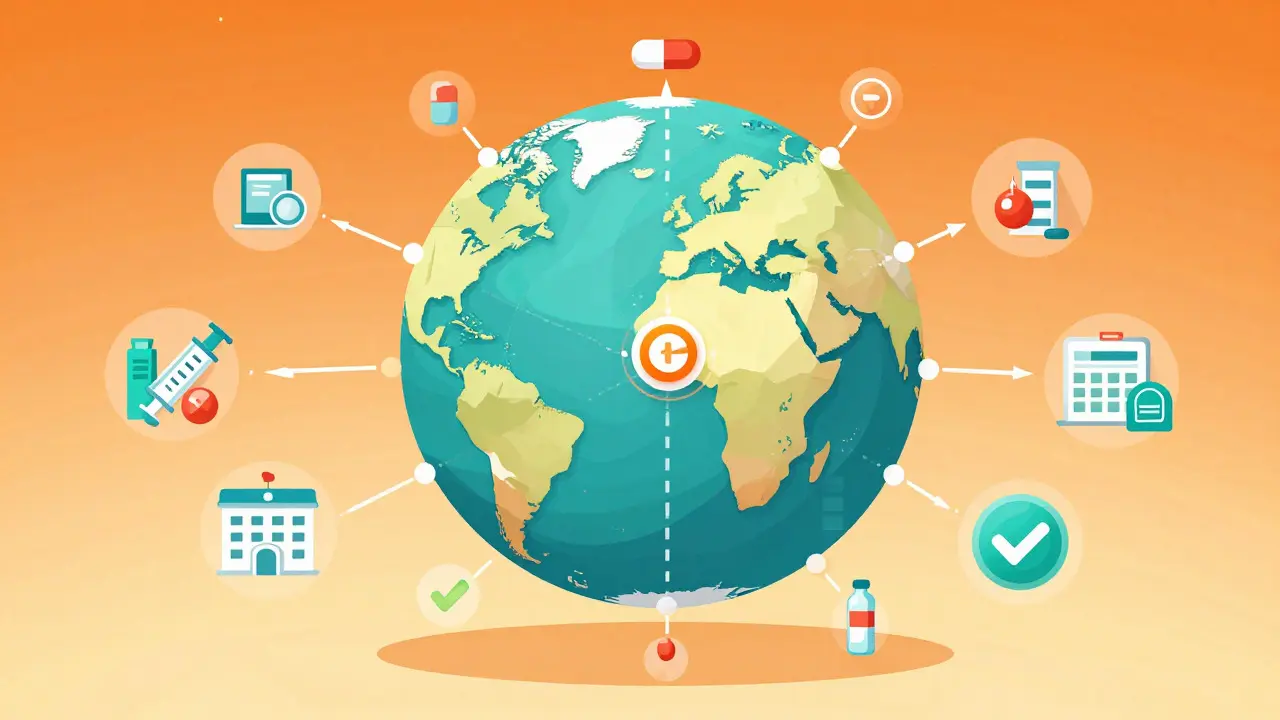
While US-focused updates dominate local practice, the WHO’s September 2025 guideline sets the global standard. It outlines eight critical components for balanced national policies:
- Evidence-driven access decisions
- Supply chain innovations using digital tracking tools
- Legal reforms protecting patient rights to possess prescribed controlled medicines
- Comprehensive healthcare professional training
- Public education campaigns
- Robust monitoring systems balancing transparency with patient privacy
- Integration with national health insurance schemes
- Standardized protocols for managing substance use disorders
Dr. Tedros Adhanom Ghebreyesus, WHO Director-General, called this guideline "a critical tool for countries to ensure no patient is left to suffer or die needlessly from a lack of essential medicines." As of August 2025, 47 countries have reported baseline medication error data, though only 12 have established comprehensive national action plans. The goal remains ambitious: a 50% reduction in serious, preventable medication harm within five years.
| Organization | Key Update | Primary Focus | Implementation Timeline | Estimated Cost Impact |
|---|---|---|---|---|
| ISMP | 2025-2026 Community Pharmacy Best Practices | Operational pharmacy workflows, dosing verification | Phased: 30 days to 18 months | $8,200 avg. for tech integration |
| NIOSH | Updated List of Hazardous Drugs | Occupational safety, oncology handling | Immediate upon publication | $15,000-$50,000 per pharmacy |
| CMS | 2025 Patient Safety Measures | Adherence metrics, Star Ratings | Continuous enrollment methodology | Variable based on plan size |
| WHO | Balanced National Controlled Medicines Policies | Global access vs. misuse balance | Multi-year systemic change | Policy-level, varies by country |
Implementation Challenges and Real-World Feedback
On paper, these guidelines look straightforward. In practice, they are resource-intensive. A June 2025 survey by the National Community Pharmacists Association found that 78% of independent pharmacy owners found the ISMP best practices "valuable but resource-intensive to implement fully," with 62% citing technology costs as the primary barrier.
Staff resistance is another hurdle. The ASHP 2025 Medication Safety Survey reported that 52% of facilities faced staff resistance to workflow changes, and 47% struggled to find time for safety meetings. Successful implementations typically involve multidisciplinary safety committees meeting biweekly and dedicated safety officers. Sarah Chen, PharmD, from a Texas community pharmacy chain, noted that while the weight-based verification protocol reduced errors significantly, it required substantial retraining time. Meanwhile, long-term care pharmacists reported a 45% increase in documentation time due to new CMS measure specifications, though 72% acknowledged improved medication management for residents with dementia.
Future Trajectory: AI and Increased Scrutiny
The trend is moving toward automation and prediction. Gartner predicts that by 2027, 65% of medication safety interventions will incorporate artificial intelligence for error prediction and prevention. MedAware’s 2025 study showed a 41% reduction in serious medication errors using AI-driven clinical decision support. The FDA has also signaled increased scrutiny, issuing 23 drug safety communications in the first eight months of 2025 compared to 19 in the same period in 2024. Commissioner Robert Califf indicated that the FDA will issue at least two major medication safety communications per month through 2026.
For healthcare leaders, the message is clear: the era of voluntary, sporadic safety efforts is over. The convergence of ISMP, WHO, CMS, NIOSH, and FDA updates suggests a sustained, coordinated global effort. The potential payoff is massive-WHO modeling estimates that these combined efforts could prevent an estimated 2.3 million serious medication errors annually across healthcare settings.
What are the immediate actions required for community pharmacies under the new ISMP guidelines?
Within 30 days, pharmacies should establish patient engagement protocols and high-alert medication verification processes. Medium-term actions (3-6 months) involve technology integration for barcode scanning, while long-term actions (6-18 months) focus on comprehensive system redesigns.
How much does it cost to comply with the new NIOSH hazardous drug handling requirements?
Based on the 2025 NCPA Economic and Technology Survey, implementation costs for containment primary engineering controls (C-PECs) range from $15,000 to $50,000 per pharmacy, depending on the scale of operations and existing infrastructure.
Do CMS Patient Safety measures apply to all Medicare Part D plans?
Yes, the 2025 measures transition remaining Part D Patient Safety measures to continuous enrollment methodology. Performance on metrics like ADH-Statins and OHD directly impacts Star Ratings, which influence plan enrollment and reimbursement.
What is the WHO's target for reducing medication harm?
The WHO's 'Medication Without Harm' program targets a 50% reduction in serious, preventable medication harm globally within a 5-year timeframe, as established in their 2017 initiative and reinforced by the 2025 guideline framework.
Are there any new drugs added to the NIOSH hazardous list in 2025?
Yes, on July 17, 2025, three additional agents were added: datopotamab deruxtecan (Datroway®), treosulfan (Grafapex™), and telisotuzumab vedotin (Emrelis™). All are classified under antineoplastic agents.