
Travel Safety Checklist: Anticoagulant Management
Quick Reminder: Warning Signs
If you experience unilateral leg swelling, calf tenderness, or sudden shortness of breath during your trip, seek emergency medical attention immediately.
Imagine you're finally on that long-haul flight to a dream destination, but instead of relaxing, you're worrying about whether you've missed a dose or if the local cuisine in your destination will mess with your medication. For anyone on anticoagulants, traveling isn't just about packing a suitcase; it's about managing a complex biological balance. Between the low oxygen levels in airplane cabins and the hours of immobility, the risk of a blood clot-like blood thinners are designed to prevent-actually goes up. The good news is that with a few practical tweaks to your routine, you can navigate the globe without compromising your health.
| Feature | Warfarin (VKA) | DOACs (e.g., Apixaban, Rivaroxaban) |
|---|---|---|
| Monitoring | Regular INR blood tests required | No routine blood tests needed |
| Dietary Impact | High (Vitamin K sensitivity) | Minimal to none |
| Onset of Action | Slow / Delayed | Rapid (usually within 2 hours) |
| Travel Convenience | Complex (requires tracking booklets) | High (predictable dosing) |
Understanding Your Medication: The Traveler's Perspective
Not all blood thinners work the same way. If you're using Warfarin is a vitamin K antagonist (VKA) that requires strict monitoring of the International Normalized Ratio (INR), your travel prep is a bit more intensive. Because Warfarin is sensitive to what you eat, a sudden switch to foreign greens or different vegetable oils can swing your levels in a dangerous direction.
On the other hand, many travelers now use Direct Oral Anticoagulants (or DOACs) is a class of medications including apixaban, rivaroxaban, and dabigatran that act directly on clotting factors without requiring constant blood monitoring. These are generally preferred for trips because they have predictable effects and don't care if you decide to try a local salad. They hit your system fast-usually within two hours-making them much easier to manage when you're hopping between time zones.
Taming the Time Zone Trap
One of the biggest risks when traveling isn't the medication itself, but the schedule. When you cross five or six time zones, your internal clock gets scrambled, and it's incredibly easy to forget a dose or accidentally double up. Missing a dose of a DOAC is particularly risky because these drugs only work for about 12 to 24 hours before they wear off.
The best way to beat this is to stop relying on your memory. Set a digital alarm on your phone or smartwatch that stays consistent with your home time, or use a dedicated medication app. If you're on Warfarin, you'll need to be even more careful; ensure you have a backup supply of different tablet strengths (like extra 1mg pills) in case your doctor needs to adjust your dose remotely or you find a clinic abroad that suggests a tweak.

The Flight Fight: Preventing DVT in the Air
Air travel is a perfect storm for Venous Thromboembolism is a condition where blood clots form in a vein, often in the leg (DVT), which can then travel to the lungs (PE). Low cabin pressure and decreased oxygen levels make your blood slightly more prone to clotting, and sitting still for ten hours doesn't help.
If your flight is six hours or longer, you can't just sit there. Make it a point to get up and walk every two to three hours. If the plane is full and you're stuck in a middle seat, do "seat gymnastics": flex your ankles, rotate your feet, and lift your knees. Stay hydrated by choosing water over alcohol or sugary sodas; dehydration thickens your blood, which is exactly what you're trying to avoid.
Essential Gear and Documentation
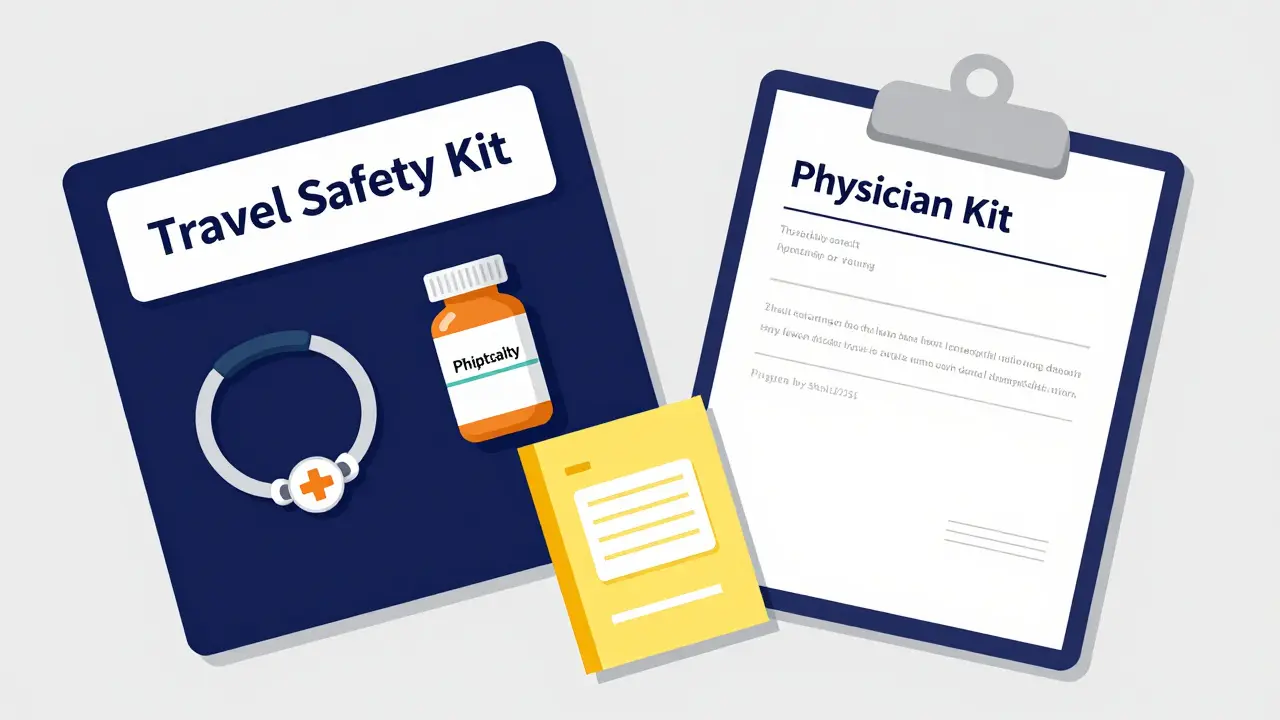
When you're in a foreign country and need medical help, "I take a blood thinner" isn't specific enough. You need a paper trail. For Warfarin users, the "yellow booklet" containing your INR history and dosing regime is non-negotiable. Keep it on your person at all times, not packed in a suitcase.
For everyone else, a simple medical alert bracelet or a card in your wallet stating the specific medication, dose, and the reason you're taking it can save critical time in an emergency. Also, keep your medications in their original pharmacy packaging. This avoids issues with customs and makes it easier for foreign pharmacists to identify the drug if you need a replacement.
Managing High-Risk Activities Abroad
Some vacation activities carry extra risks for people on anticoagulants. For instance, if you're planning on scuba diving, be aware that Decompression Sickness relates to the formation of bubbles in the blood during ascent, which can cause severe internal bleeding in people on blood thinners. Even a simple struggle to equalize ear pressure during a flight can potentially lead to bleeding in the ears or spinal cord if your levels are too high.
Additionally, if you've had a blood clot recently, the general medical consensus is to wait at least four weeks before embarking on a major trip. Your body needs time to stabilize, and the stress of travel can be a trigger for recurrence.
Can I drink alcohol while on blood thinners during my trip?
It's best to keep it very moderate. Alcohol can dehydrate you, which increases clotting risk, and some drinks can interfere with how your medication works-especially Warfarin. Stick to water and limit alcohol to an occasional glass.
What happens if I forget a dose while traveling?
Don't panic, but act quickly. Check your medication's specific guidelines or call your doctor immediately. For DOACs, because they have a short half-life, missing a dose can leave you unprotected relatively quickly.
Do I need a special prescription for customs?
Yes, it is highly recommended to carry a signed letter from your physician detailing your condition and the medications you are carrying. This prevents delays at border control and ensures you have a legal record of your prescription.
Are DOACs safer than Warfarin for long flights?
Generally, yes. Because they don't require constant blood tests and have fewer food interactions, they are much easier to manage in a travel setting. However, your doctor chooses the drug based on your specific medical needs, so always follow their lead.
What are the warning signs of a clot while traveling?
Look for swelling in one leg, pain or tenderness in the calf, or sudden shortness of breath. If you notice these, seek medical attention immediately. Most global medical centers are well-equipped to handle DVT.
Next Steps for Your Trip
Before you head to the airport, sit down with your doctor and run through your itinerary. If you're crossing multiple time zones, ask for a written "adjustment schedule" for your doses. Check your travel insurance to ensure it covers pre-existing conditions related to anticoagulation. Finally, pack your medications in your carry-on bag-never in checked luggage-to ensure you have access to them even if your bags go missing.
Comments
Totally agree on the compression socks point! They really do make a difference when you're stuck in a cramped seat for twelve hours. Maybe we could also suggest staying away from high-sodium airport snacks since bloating can make the leg discomfort even worse!
just bring the meds in carry on dont risk it
The pharma companies just want us dependent on DOACs. They push these over Warfarin because they're more profitable. Wake up people.
Actually, the reason DOACs are better isn't just convenience. They target specific clotting factors like Xa or thrombin, whereas Warfarin just messes with the whole Vitamin K cycle. It's basic pharmacology.
It is quite amusing how people think a simple list of tips can solve the existential dread of medical fragility while traveling. We are all just biological machines waiting for a glitch, and while this guide is a decent attempt at mitigation, it ignores the deeper irony that the very act of seeking adventure is what puts us at risk. One must wonder if the destination is even worth the meticulous calculation of INR levels and timing offsets. Truly, we are prisoners to our own chemistry.
I feel you, but try to stay positive! Just take it one step at a time and you'll have a great trip. It's all about being prepared!
Omg yes!!! 🌟 Just focus on the good vibes and the beautiful places you'll see!!! ✈️🌍 It's all about finding that balance between safety and joy!!! ❤️✨
I LOVE the energy here!!! Just keep moving those legs and STAY HYDRATED!!! You've got this!!! 👏👏👏
there is a certain peace in the ritual of medication management... it forces us to be present in our bodies when we are usually trying to escape them through travel
I believe it is of utmost importance to maintain a collaborative relationship with one's healthcare provider to ensure all precautions are meticulously followed during international excursions.