
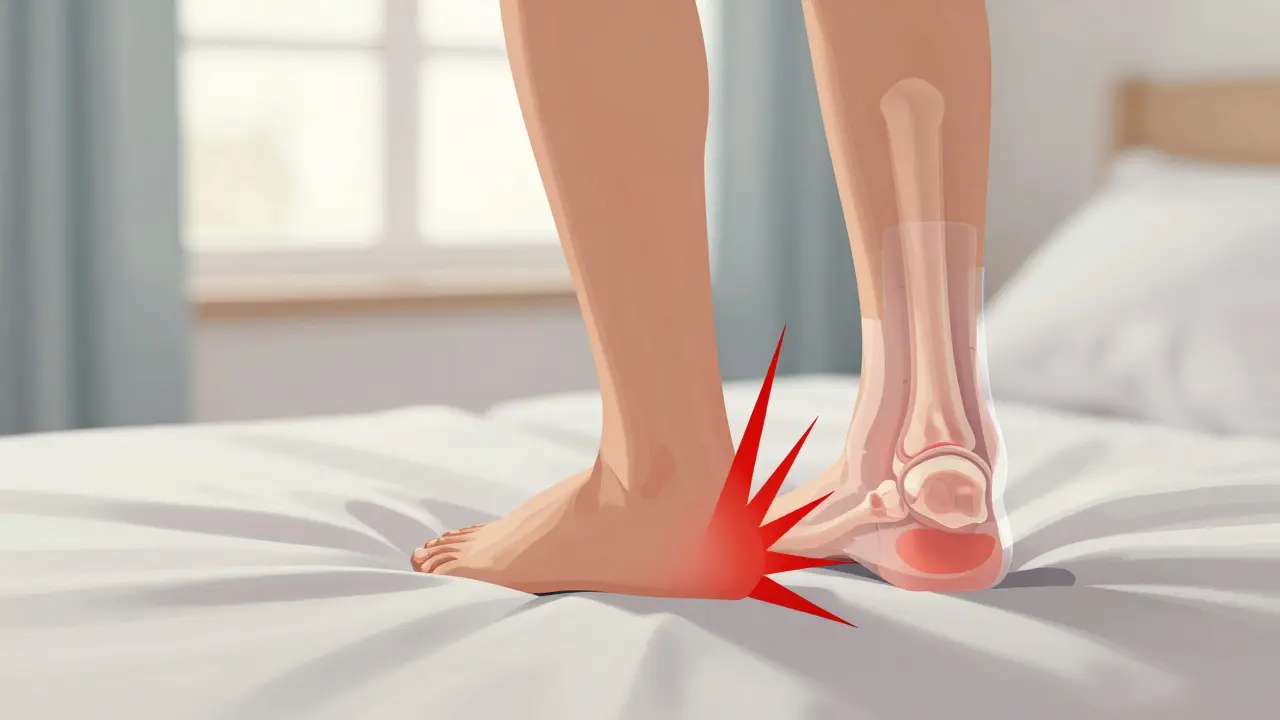
Heel pain that hits hardest when you first step out of bed? You’re not alone. About 10% of adults deal with plantar fasciitis at some point - and most of them are between 40 and 60 years old. It’s not just an old person’s problem, though. Runners, teachers, factory workers, and anyone who stands for hours all day are at high risk. The good news? Most cases get better with the right approach - no surgery needed.
What’s Really Going On With Your Heel?
For years, doctors called it plantar fasciitis, implying inflammation. But that’s misleading. Modern research shows it’s not inflamed tissue - it’s degenerated tissue. The correct term now is plantar fasciopathy. The plantar fascia is a thick band of connective tissue running from your heel to your toes. It acts like a shock absorber and holds up your arch. When it’s overused, it starts to break down at its attachment point on the heel bone. Tiny tears build up. Blood flow drops. The tissue becomes stiff, thickened, and painful.
It’s not caused by a heel spur. In fact, 80% of people with plantar fasciopathy have no spurs on X-rays. Meanwhile, 15% of people with no pain at all show spurs on imaging. So if your doctor orders an X-ray and says, “You’ve got a heel spur,” that’s not your diagnosis. Your diagnosis is the pain you feel when you take your first steps in the morning.
How Do You Know It’s Plantar Fasciopathy?
The symptoms are very specific. You’ll feel a sharp, stabbing pain on the inside of your heel, right where your arch starts. It’s worst with the first few steps after sleeping or sitting for a long time. After walking for 5 to 10 minutes, the pain often fades - but comes back by the end of the day, especially if you’ve been on your feet.
Doctors look for three key signs:
- Pain when pressing 2-3 centimeters forward from the inner heel bone
- Severe pain during the first steps after rest
- Pain when you pull your toes upward toward your shin
An ultrasound can confirm it - if the fascia is thicker than 4.0 mm (normal is 2.0-3.5 mm), that’s a strong indicator. But you don’t need imaging to start treatment. If your symptoms match, you can begin managing it right away.
Who’s Most at Risk?
It’s not random. Certain factors make plantar fasciopathy much more likely:
- BMI over 27 - This increases your risk by more than four times. Every 1-point drop in BMI reduces pain by about 5.3% over six months.
- Limited ankle flexibility - If you can’t bend your ankle upward more than 10 degrees, your risk jumps nearly fourfold.
- Flat feet - Low arches put extra strain on the plantar fascia.
- Standing more than 4 hours a day - Teachers, nurses, and retail workers have among the highest rates.
- Running over 10 miles a week - Especially on hard surfaces or with worn-out shoes.
And here’s something surprising: sedentary people with excess weight are actually more likely to develop it than active runners. The combination of poor foot mechanics and added body weight is the perfect storm.
What It’s Not - Ruling Out Other Causes
Not all heel pain is plantar fasciopathy. Other conditions can mimic it:
- Baxter’s neuritis - Nerve entrapment causing burning pain on the inner heel, often mistaken for fasciopathy.
- Tarsal tunnel syndrome - Numbness, tingling, or electric shocks under the foot, not just sharp heel pain.
- Stress fracture - Pain that worsens with activity and doesn’t improve with rest.
Doctors often miss these. A 2023 survey found that 42% of patients felt their condition was misdiagnosed at first - most commonly labeled as “heel spurs.” If your pain doesn’t improve with standard treatments, ask about nerve issues.
First-Line Treatment: Stretching (It’s Free and Works)
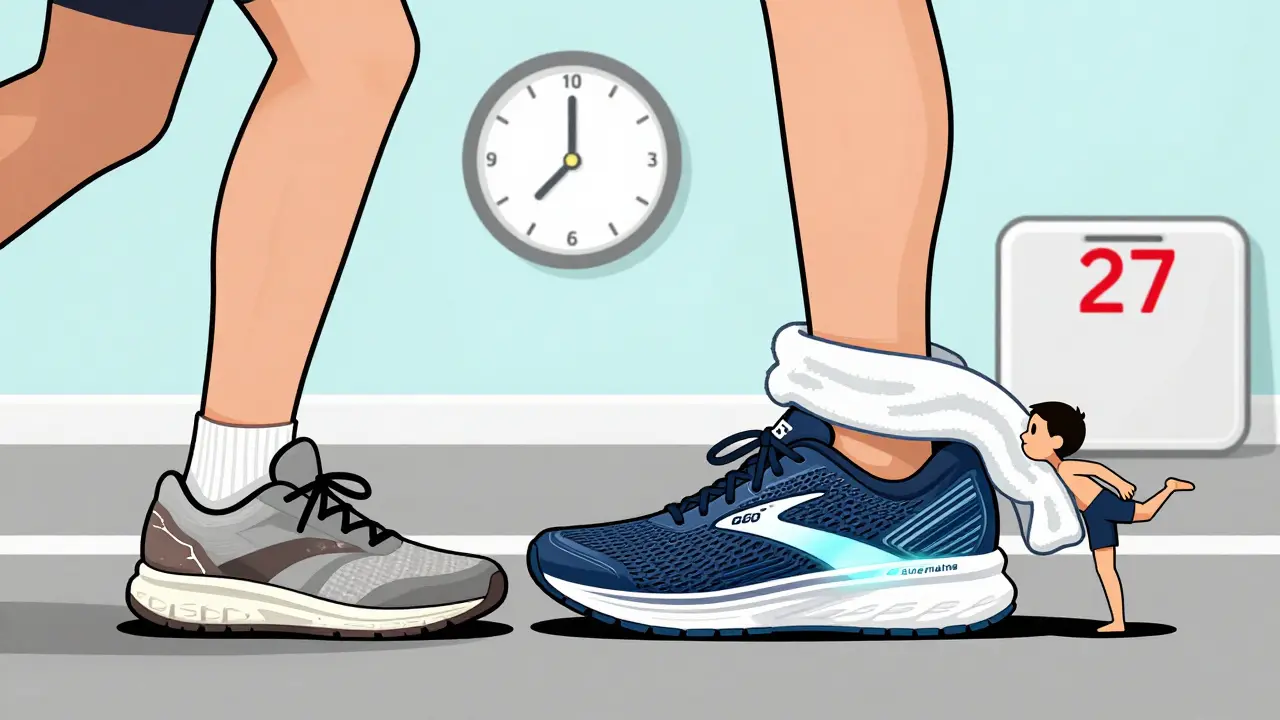
The most effective, evidence-backed treatment? Stretching - specifically, plantar fascia-specific stretching. Not calf stretches. Not general foot rolls. You need to target the fascia directly.
Here’s how to do it:
- Seated on a chair, cross your affected foot over your opposite knee.
- Loop a towel or belt around the ball of your foot.
- Gently pull your toes back toward your shin until you feel a stretch along the bottom of your foot.
- Hold for 10 seconds.
- Repeat 10 times.
- Do this 3 times a day - morning, afternoon, and night.
Studies show this method reduces pain 37% more than standard calf stretches after just 4 weeks. People who stick with it for 8-12 weeks report an 83% improvement. That’s better than most injections.
Don’t stretch through sharp pain. Mild tension is fine. If it hurts badly, ease off. Consistency matters more than intensity. You need to do this daily for at least 6-8 weeks to see real results. And 92% of people who stick to it get relief.
Other Proven Treatments - What Actually Works
Stretching alone helps many, but most people need a combination. Here’s what the data says about other options:
Night Splints
These keep your foot at a 90-degree angle while you sleep, preventing the fascia from tightening overnight. They work - 72% of users see improvement in 6 weeks. But 44% quit because they’re uncomfortable. If you can tolerate them, wear them for 4-5 hours a night. Don’t expect miracles on night one.
Orthotics
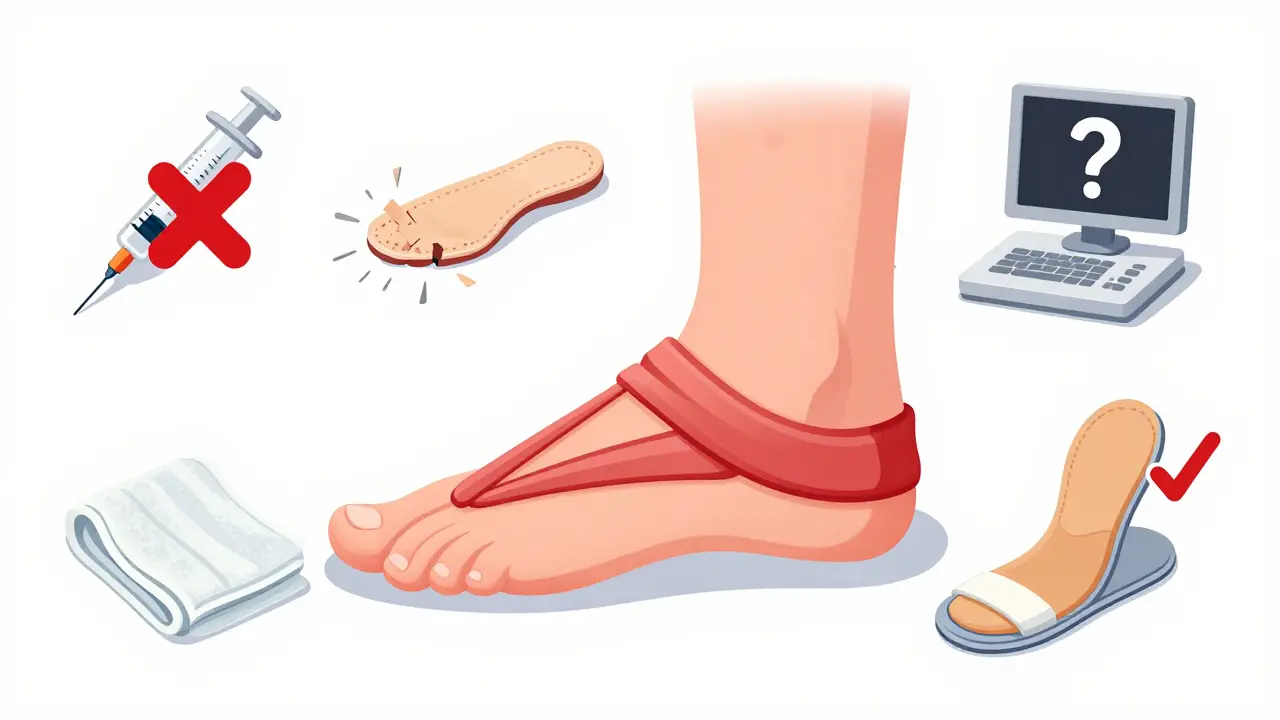
Custom orthotics reduce pain by 68% at 12 weeks. Prefabricated ones? Only 52%. That’s a big difference. But you don’t need expensive custom inserts. Look for supportive, cushioned insoles with good arch support. Brands like Superfeet or Powerstep work well for most people. Avoid flat, flimsy inserts.
Footwear
Your shoes matter. Look for a heel-to-toe drop of 10-15mm (not zero) and solid arch support. Runners swear by the Brooks Adrenaline GTS and Hoka Clifton - both scored over 79% satisfaction in 2023 reviews. Replace shoes every 300-500 miles. Worn-out soles are a major trigger.
Physical Therapy
PT combines stretching, strengthening, and manual therapy. Most people need 6-12 sessions. Medicare covers 80% after your deductible. Success rates are 76%. It’s worth it if stretching alone isn’t enough.
What Doesn’t Work - Or Can Hurt You
Some treatments are popular but risky or ineffective:
- Corticosteroid injections - They give temporary relief (about 4 weeks), but carry an 18% risk of plantar fascia rupture. Also, 22% cause fat pad atrophy - meaning your heel loses its natural cushion. The AAOS guideline says avoid them in the first 3 months.
- Ultrasound therapy - Studies show no significant benefit over placebo.
- Shoe inserts without arch support - They’re useless. If you can press your thumb through the arch, it’s not helping.
And don’t rush back to running or jumping. 72% of people who relapse did so because they returned to high-impact activity too soon. Give your foot time to heal.
Emerging Options - What’s New?
If you’ve tried everything for 3 months and still hurt, newer treatments are worth discussing:
- Radial shockwave therapy - 78% success rate at 12 weeks. Requires 3-4 sessions. Not covered by most insurance ($2,500-$3,500 out of pocket).
- PRP injections - Your own blood platelets injected into the fascia. Shows 65% pain reduction at 6 months in recent trials. Costs $800-$1,200 per injection. Insurance rarely covers it.
- Cryoplasty - A new technique using cold to target damaged tissue. Early results are promising (82% success), but it’s still experimental and not widely available.
These aren’t magic bullets. They’re for people who’ve done everything else and still struggle.
Recovery and Prevention
Most people recover fully within 10 months with conservative care. But 25-30% get it again - usually because they stopped stretching or gained weight back. Prevention is simple:
- Maintain a healthy weight
- Stretch daily, even after pain is gone
- Wear supportive shoes - no flip-flops for long walks
- Replace worn-out athletic shoes
- Strengthen your feet - try toe curls and towel scrunches
There’s no quick fix. But there’s a clear path. Stretch consistently. Support your arch. Manage your weight. Avoid shortcuts like injections unless absolutely necessary. Your feet will thank you.
Is plantar fasciitis the same as heel spurs?
No. Heel spurs are bony growths on the heel bone, often seen on X-rays. But 80% of people with plantar fasciopathy have no spurs, and 15% of people with no pain have spurs. The pain comes from the degenerated tissue in the plantar fascia, not the spur itself. Treating the spur won’t help - treating the fascia will.
How long does plantar fasciitis take to heal?
Most people see improvement within 6-8 weeks with consistent stretching and supportive footwear. Full recovery usually takes 6-12 months. Patience is key - this isn’t something that fixes itself in a few days. Skipping daily stretches delays healing.
Can I still run with plantar fasciitis?
You can, but you must modify your routine. Reduce mileage, avoid hills and hard surfaces, and never run through sharp pain. Cross-train with swimming or cycling. Return to running only after pain is gone for at least 2 weeks and you’ve been stretching daily. Most recurrences happen because people rush back too soon.
Do I need custom orthotics?
Not necessarily. Prefabricated orthotics with good arch support work for most people and cost a fraction of custom ones. Custom orthotics are best if you have severe flat feet, leg length differences, or if over-the-counter options don’t help. Look for ones that don’t collapse under pressure - if you can press your thumb into the arch, it’s not supportive enough.
Are injections safe for plantar fasciitis?
Steroid injections offer short-term relief but carry real risks: plantar fascia rupture (18%), fat pad atrophy (22%), and tissue weakening. They’re not recommended in the first 3 months of symptoms. Only consider them if you’ve tried stretching, orthotics, and PT for 3-6 months with no improvement - and even then, limit to one injection. Don’t use them as a first-line fix.
What to Do Next
If you’re dealing with heel pain right now, start today. Do the towel stretch three times before you even get out of bed. Put on supportive shoes - no barefoot walking around the house. Check your current shoes - are the soles worn flat? Replace them. If pain persists after 4 weeks, see a physical therapist. Don’t wait for it to get worse. The earlier you act, the faster you recover.
Comments
Just started the towel stretch this morning after reading this. I’ve had heel pain for 8 months and thought I needed surgery. This actually makes sense - no magic bullets, just consistency. Already feel a tiny bit better after 3 rounds. Thank you for laying it out so clearly.
Also, replacing my shoes today. Worn-out soles were my silent enemy.
Also - no more barefoot walking around the house. Never realized how much that hurt.
Still skeptical about night splints, but I’ll try them for a week. No pain, no gain, right?
Yall in USA overthink everything. In Nigeria we just walk barefoot on hot sand and its fine. This plantar what? Its just weak feet. You sit too much, eat too much, then cry when your feet hurt. No wonder you need 12 week programs. We dont have time for this. Just walk more. Less shoes. Less fear.
Also your shoes cost too much. Hoka? Bro its a shoe. Not a temple.
Plantar fasciopathy not fasciitis. Important. Also BMI over 27 = 4x risk. Ankle dorsiflexion <10° = 4x risk. Ultrasound >4mm = diagnostic. Stretching protocol = 83% improvement at 12 weeks. Steroid injections = 18% rupture risk. Orthotics = custom 68% vs prefabricated 52%. Shockwave = 78% success. PRP = 65% at 6mo. No ultrasound needed to start. No spurs = irrelevant. Stop blaming bones. Start fixing mechanics.
And yes you’re still running too much.
I’ve been a teacher for 14 years. My feet have been screaming since year three. I tried everything - ice, massage guns, expensive inserts, even acupuncture. Nothing worked until I started the towel stretch. Not the calf stretch. The actual fascia stretch.
I do it while brushing my teeth. Three times a day. No excuses. I used to think I was too busy. Turns out I was just too stubborn.
Also - switched to Brooks Adrenaline. Game changer. I didn’t know shoes could feel like clouds.
Thanks for this. I wish I’d read it two years ago.
You got this. Seriously. I was in the same spot - pain every morning, avoided walking, hated my shoes. Then I started the stretch. Didn’t feel better right away. But I kept going. Week 3? Still sore. Week 5? Barely noticed it. Week 8? I went for a walk. No pain. No meds. No injections.
It’s not sexy. It’s not fast. But it works. Just stick with it. Your feet are worth it.
And if you’re thinking about those expensive custom orthotics? Try Superfeet first. They’re cheaper and just as good for most people.
You’re not broken. You just need a little consistency.
OMG YES. I just did the stretch before I got out of bed and I literally gasped - it was so much less painful than yesterday?!?!?!!? I thought I was doomed to forever walk like a penguin. I’ve been doing this for 3 days and already feel like a new person. Also - I threw out my flip-flops. No more. Ever. I even bought new sneakers. I’m obsessed. Thank you thank you thank you. I’m telling my whole office about this.
Also - night splints are weird but I’m trying them. I look like a robot foot in bed. Worth it.
Love how this post cuts through the noise. So many people are sold on quick fixes - injections, laser therapy, magic insoles - but the real answer is just… doing the work. The stretch. The shoes. The weight management. It’s boring. It’s slow. But it’s real.
I’ve been coaching runners with this issue for years. The ones who succeed? They don’t skip days. They don’t blame their shoes. They don’t wait for pain to disappear before they start. They start *while* it hurts.
And for the love of all things holy - stop blaming heel spurs. That’s like blaming a cracked windshield for a car accident. The problem’s in the driver, not the glass.
Also - if you’re reading this and thinking ‘I don’t have time’ - you’re the exact person who needs this the most. Five minutes. Three times a day. That’s it.
While the stretching protocol is evidence-based, it’s incomplete without addressing proximal biomechanical drivers. The plantar fascia is a kinetic chain component - dysfunction often originates in hip abductor weakness, gluteal inhibition, or altered gait kinematics. Static stretching alone is palliative. A comprehensive rehab protocol must include eccentric heel drops, proprioceptive training, and neuromuscular re-education. Without addressing proximal deficits, recurrence rates remain elevated despite local interventions. Recommend integrating the protocol with a physical therapist who understands regional interdependence. Also - avoid foam rolling the arch. It’s ineffective and potentially damaging to the fat pad.