

When your kidneys fail, life changes. Dialysis keeps you alive, but it doesn’t give you back your life. A kidney transplant can. It’s not a cure, but for most people with end-stage kidney disease, it’s the best shot at feeling normal again-sleeping through the night, eating what you want, traveling without planning around dialysis machines. And it works. About 85% of people who get a kidney transplant are still alive five years later. On dialysis? That number drops to about 50%. The difference isn’t just numbers. It’s freedom.
Who Can Get a Kidney Transplant?
You don’t need to be young or perfect to qualify. But you do need to be well enough to survive the surgery and stick with the lifelong care that follows. Most transplant centers in the UK and US agree on the basics: you must have end-stage renal disease (ESRD), meaning your kidneys are working at 15% or less of normal capacity. That’s measured by your glomerular filtration rate (GFR). If your GFR is 20 mL/min or lower, you’re typically eligible. Some centers, like Mayo Clinic, may consider you even if your GFR is up to 25 mL/min-if your kidney function is dropping fast or you have a living donor lined up.Age isn’t a hard barrier. You can be 70, 75, or older and still qualify-if your heart, lungs, and overall health are strong. UCLA doesn’t set an age limit. Vanderbilt looks at frailty, not just years. They check grip strength, walking speed, and weight loss. If you’re losing muscle, moving slowly, or feeling constantly tired, that’s a red flag-even if you’re only 60.
Weight matters too. A BMI over 35 makes the surgery riskier. Over 45? Most centers won’t operate until you lose weight. Why? Fat increases infection risk, makes surgery harder, and cuts the life of the new kidney short. Studies show obese patients have a 35% higher chance of surgical complications and a 20% higher chance of graft failure.
Your heart and lungs have to be stable. If you have severe pulmonary hypertension-pressure in your lung arteries above 70 mm Hg-you won’t qualify. Same if you’re on oxygen long-term because of COPD. Your heart needs to pump well: an ejection fraction below 35% is usually a no-go. You’ll get an echocardiogram, stress test, and maybe a cardiac catheter if you’re over 50 or have risk factors like diabetes or high blood pressure.
What Disqualifies You?
Some things are absolute deal-breakers. If you have active cancer that hasn’t been treated or is likely to come back, you’re not eligible. Most centers require you to be cancer-free for at least two years-sometimes five-before they’ll consider you. Same with infections: if you have an untreated HIV infection with a CD4 count under 200 or a detectable viral load, you’re out. Hepatitis B with active virus in your blood? Also a disqualifier at many centers.Drug and alcohol abuse is another hard stop. If you’re still using opioids, cocaine, or drinking heavily, transplant teams won’t risk giving you a kidney. It’s not about judgment-it’s about survival. You have to take anti-rejection drugs every single day, for life. Miss one dose? Risk rejection. Miss a bunch? Lose the kidney. If you can’t manage your own care now, you won’t manage it after transplant.
Severe, untreated mental illness can also block you. Depression? Anxiety? That’s fine if you’re on medication and seeing a therapist. But if you’re not taking your meds, skipping appointments, or having psychotic episodes? That’s a problem. Transplant centers need to know you’ll show up for follow-ups, take your pills, and speak up if something feels wrong.
In the UK, NHS Blood and Transplant says you must be ‘well enough to cope with major surgery’ and the transplant must have a ‘good chance of success.’ That’s the bottom line. It’s not about being perfect. It’s about being capable.
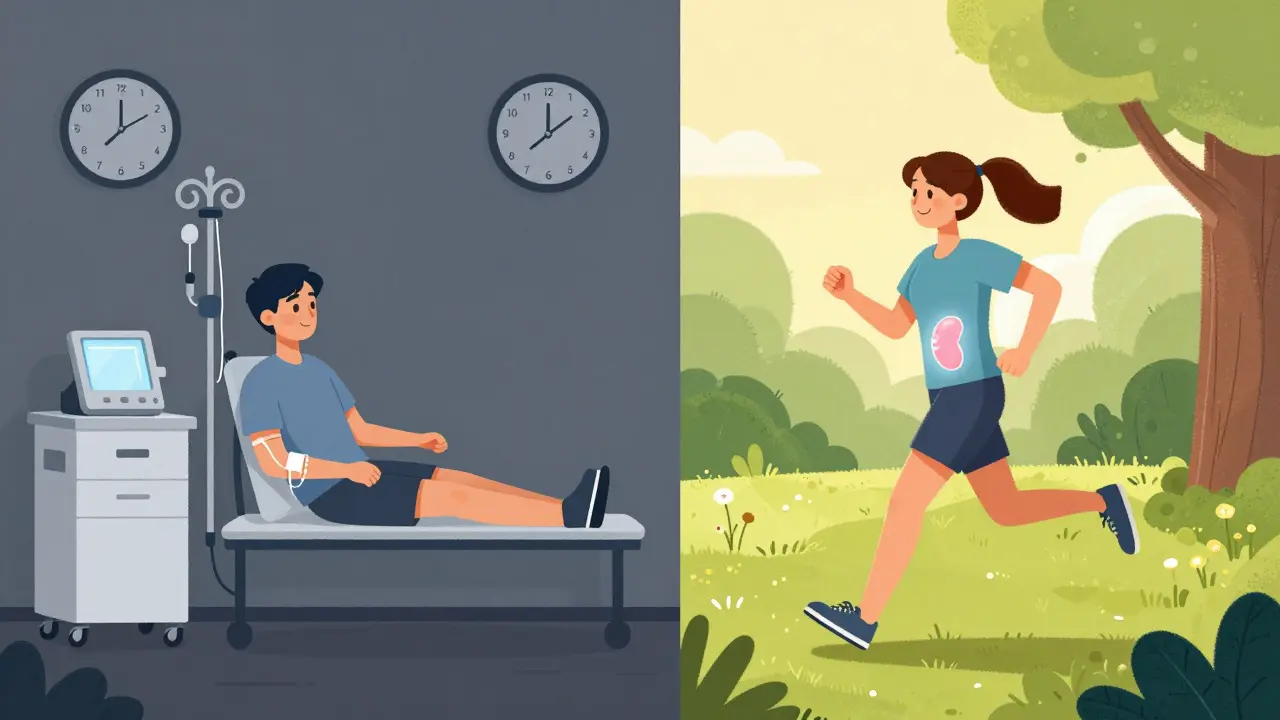
The Surgery: What to Expect
The operation itself takes about three to four hours. You’ll be under general anesthesia. The surgeon places the new kidney in your lower abdomen-usually on the right or left side. They connect its main artery and vein to your own blood vessels. Then they attach the ureter (the tube that carries urine) to your bladder. Your original kidneys? They stay in. Unless they’re infected, causing high blood pressure, or painfully swollen, there’s no reason to remove them.When the blood starts flowing into the new kidney, you’ll often see it turn pink and start making urine right away. That’s a good sign. But sometimes, especially with kidneys from deceased donors, the organ takes a little time to wake up. About 20% of these transplants need temporary dialysis for a few days after surgery. That’s normal. It doesn’t mean the transplant failed.
You’ll stay in the hospital for about three to seven days. Pain is managed with medication. You’ll be up and walking the next day-movement helps your body heal. Nurses will teach you how to check your weight, blood pressure, and temperature every day. You’ll learn to spot warning signs: fever, swelling, sudden weight gain, or less urine. These could mean rejection or infection.
Life After Transplant: The Real Work Begins
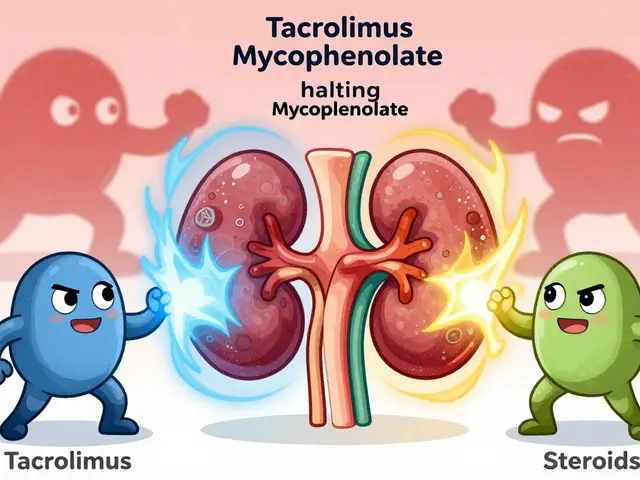
The surgery is just the start. The real challenge is staying alive with a new kidney. That means taking immunosuppressants every single day, for the rest of your life. These drugs stop your immune system from attacking the new kidney. Without them, your body sees the kidney as an invader-and tries to destroy it.Most people take a combination of three drugs: a calcineurin inhibitor (like tacrolimus), an antiproliferative agent (like mycophenolate), and a steroid (like prednisone). Some get an extra shot of antibodies right after surgery to give the new kidney a better start.
These drugs save your kidney-but they come with costs. You’re more likely to get infections. You might develop high blood pressure, diabetes, or high cholesterol. Bone thinning and weight gain are common. Some people get skin cancer. That’s why you need regular blood tests, kidney ultrasounds, and doctor visits.
For the first month, you’ll be seen weekly. Then monthly for the next three to six months. After that, every three months. And every year, forever. You’ll need blood tests to check your kidney function, drug levels, and signs of rejection. Even if you feel fine, you go. Skipping appointments is one of the biggest reasons transplants fail.
Living donor kidneys last longer. About 97% are still working after one year. Deceased donor kidneys? Around 93%. Five years out, 85% of living donor kidneys are still functioning. For deceased donor kidneys, it’s 78%. That’s why having a living donor-someone who donates while alive-is the gold standard. It’s not just about speed. It’s about survival.
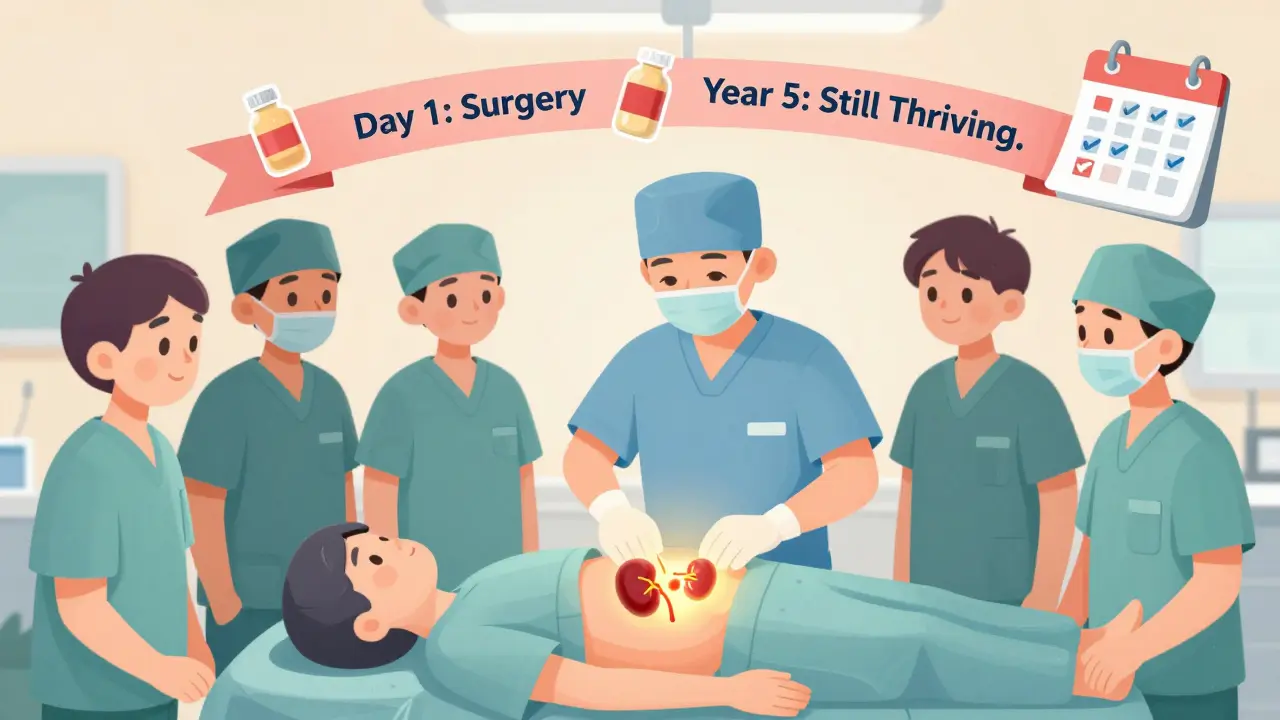
What’s New in Kidney Transplants?
The field is moving fast. Ten years ago, we used to throw away kidneys from older donors or those with high blood pressure. Now, we use them. The Kidney Donor Profile Index (KDPI) helps match kidneys with the longest expected life to the patients who need them most. A kidney with a 90% KDPI score? It’s not ideal. But if you’re 70 and on dialysis, it’s better than waiting years for a ‘perfect’ kidney.Organ preservation is improving too. New machines keep kidneys alive longer outside the body, giving surgeons more time to match them properly. And research is underway to help people stop taking immunosuppressants. Clinical trials at Stanford and the University of Minnesota are testing ways to train the immune system to accept the new kidney without drugs. If it works, it could change everything.
For now, the best advice is simple: take your pills. Go to your appointments. Eat well. Move. Don’t smoke. Avoid people who are sick. And if something feels off-call your team. Don’t wait. Your new kidney doesn’t speak. It can’t tell you when it’s hurting. Only you can notice the signs.
Can You Live a Normal Life After a Transplant?
Yes. You can work. Travel. Have kids. Play with your grandkids. Most people return to work within three to six months. Many go back to full-time jobs. You can still get pregnant-though you’ll need close monitoring. You can even play sports, though contact sports like football are discouraged.But normal doesn’t mean easy. It means responsibility. You’re not just managing a disease anymore. You’re managing a miracle. And miracles need care.
Can you get a kidney transplant if you’re over 70?
Yes, age alone doesn’t disqualify you. Many transplant centers, including UCLA and NHS Blood and Transplant, evaluate older patients based on overall health-not just age. If your heart, lungs, and mental health are strong, and you have good support at home, you can be a candidate. Frailty, not age, is the real concern. Tests for grip strength, walking speed, and weight loss help determine if you can handle the surgery and recovery.
How long do kidney transplants last?
Living donor kidneys last longer. On average, they work for 15-20 years. Deceased donor kidneys last about 10-15 years. The 5-year graft survival rate is 85% for living donor transplants and 78% for deceased donor transplants. Some transplants last 25+ years. But rejection, infection, or side effects from medications can shorten that. Taking your drugs and going to all follow-ups gives you the best chance.
What happens if the transplant fails?
If the new kidney stops working, you go back to dialysis. You can also be re-listed for another transplant. Many people get a second-or even third-transplant. Success rates for second transplants are still high. The key is staying healthy while waiting. Avoid infections, keep your weight down, and stay active. Your chances improve if you’re in good shape when you go back on the list.
Do you need to be on dialysis before getting a transplant?
Not always. Many people get transplants before starting dialysis, especially if they have a living donor. This is called pre-emptive transplantation. Studies show it leads to better long-term outcomes than starting on dialysis first. You just need to be close to needing dialysis-usually with a GFR below 20 mL/min-and your medical team must agree you’re ready.
Can you drink alcohol after a kidney transplant?
Moderation is key. Most transplant teams allow one drink a day for women and two for men-only if your liver is healthy and your medications aren’t affected. But alcohol can raise blood pressure, damage the liver, and interact with immunosuppressants. Many patients choose to avoid it completely. Always check with your transplant team before drinking.
What are the biggest risks after a transplant?
The biggest risks are rejection, infection, and side effects from anti-rejection drugs. Rejection can happen anytime, even years later. Infections are more common because your immune system is suppressed. Drug side effects include high blood pressure, diabetes, weight gain, bone thinning, and increased skin cancer risk. Regular check-ups catch these early. Missing doses or skipping appointments increases all these risks dramatically.
Can you get a kidney transplant if you have diabetes?
Yes, if your diabetes is well-controlled. Many people with diabetic kidney failure get transplants. But your blood sugar must be stable-HbA1c below 7.5% is usually required. You’ll also need a heart check, since diabetes raises your risk of heart disease. Some centers offer combined kidney-pancreas transplants for type 1 diabetics. That’s a more complex surgery but can eliminate the need for insulin.
How do you find a living donor?
Start by talking to family and close friends. About 60% of living donors are relatives. But you can also ask coworkers, neighbors, or even strangers through social media or donor registries. Donors must be healthy, over 18, and willing to undergo testing. They don’t need to be a perfect match-modern drugs make compatibility easier. The NHS and UNOS have programs to help match incompatible pairs through kidney exchange chains. Don’t be afraid to ask.
Comments
Just saw a guy on dialysis for 8 years finally get a living donor kidney last month. He’s back coaching his kid’s soccer team. That’s the real win-not just surviving, but living. The meds are a pain, yeah, but they’re cheaper than a lifetime of 3x-weekly dialysis rides and frozen meals.
They don’t tell you the truth-transplants are just big pharma’s way to lock you into lifelong drug sales. Tacrolimus costs $2k/month. Who can afford that without insurance? And don’t get me started on how they ‘select’ who gets a kidney-rich folks jump the line while poor people die waiting.
my cousin got one 12 years ago and still runs marathons. she takes her pills like clockwork and never misses a checkup. it’s not magic, it’s discipline. and yeah, she’s alive because she chose to be.
In the UK, we have the NHS-and while wait times can be long, no one’s denied care because they can’t pay. I’ve met people who traveled from India just to get a transplant here because their home system couldn’t help them. It’s not perfect, but it’s human.
In India, many families pool money for years to get a transplant. Some even sell land or borrow from loan sharks. But the real tragedy? Most donors are relatives-not strangers. We need better public awareness. A kidney isn’t a luxury. It’s a right.
Let’s be real-transplant medicine is the closest thing we have to modern alchemy. They take a dying organ from a stranger, stitch it into your body, and suddenly you’re breathing again. The science is wild. And yet, we treat it like a routine procedure. We should be in awe.
There’s a quiet dignity in the way transplant recipients carry themselves-less fear, more gratitude. Not because they’re saints, but because they’ve stared into the abyss of chronic illness and chosen to fight, not just endure. That’s the real miracle: not the organ, but the will.
Everyone’s acting like this is some noble humanitarian effort. Newsflash: transplant centers are profit centers. They get paid per procedure, per drug, per follow-up. And the donors? Mostly poor people who got pressured into it by family guilt or financial desperation. Don’t romanticize it.
Why do we let foreigners get our organs? My cousin died waiting. Meanwhile, I read about some dude from Germany getting a kidney from a US donor. We’ve got a shortage. We should prioritize Americans first. That’s not racist-it’s patriotic.
Actually, living donor chains work better when international pairs are included. A donor in the US can match with someone in Canada, freeing up a kidney in India for someone else. It’s a global network. You don’t save lives by drawing borders around them.
My dad got a kidney in 2015. He’s 74 now. Still drives. Still makes his famous chili. The only thing he’s strict about? His meds. He says, ‘I didn’t survive dialysis just to quit now.’ Simple. True.
i just want to know… what if you hate your new kidney? what if you feel like it’s not yours? like it’s stealing your body? i mean… it’s not you… it’s a stranger’s organ… isn’t that creepy?
my uncle got a transplant last year. he cries every time he sees his donor’s family. they’re not strangers anymore. they’re family now. 💛
Just watched a documentary where a 78-year-old grandma got a kidney from her 35-year-old granddaughter. She’s now gardening, traveling, and making her famous samosas again. 🌿🍲 #TransplantWins