
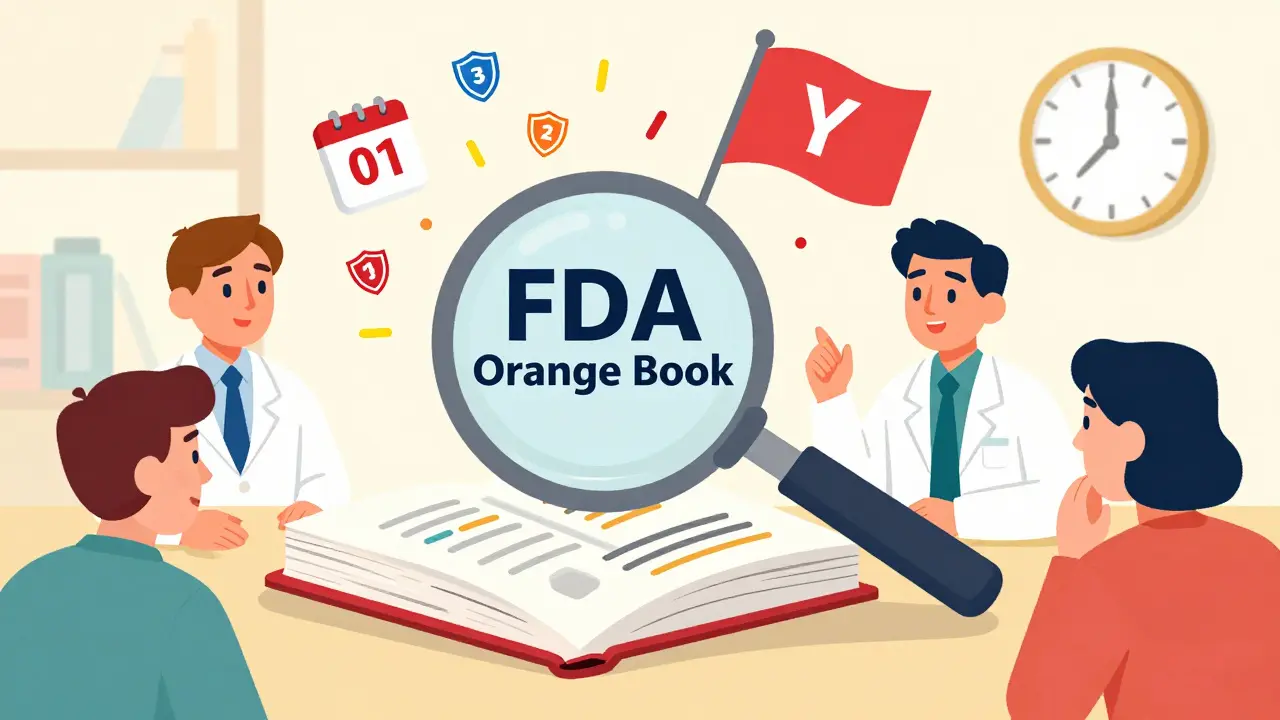
The FDA Orange Book is the single most important resource for anyone trying to figure out when a brand-name drug will lose its patent protection and allow generic versions to enter the market. If you’re a pharmacist, a generic drug manufacturer, a patient waiting for a cheaper alternative, or even a policy analyst, knowing where to find accurate patent expiration dates can save time, money, and even lives. But finding this information isn’t always straightforward. The Orange Book doesn’t just list patents-it layers in exclusivity periods, patent extensions, and flags for delisted patents. And if you don’t know what to look for, you might miss critical details that affect when a generic drug actually becomes available.
What is the FDA Orange Book?
The FDA Orange Book, officially called Approved Drug Products with Therapeutic Equivalence Evaluations, has been around since 1985. It was created under the Hatch-Waxman Act to balance innovation and access: give brand-name companies enough patent protection to recoup R&D costs, but create a clear path for generics to launch once those protections expire. It’s not just a list of drugs-it’s a legal roadmap for the entire generic drug industry.
Every approved small-molecule drug in the U.S. that has patents or exclusivity listed gets included. That means if a drug has even one patent tied to its active ingredient, formulation, or method of use, it shows up here. The FDA updates the Orange Book daily, and the data is publicly available through its Electronic Orange Book portal. You won’t find biologics here-that’s a separate system. This is strictly for traditional pills and injections.
Where to Find Patent Expiration Dates
To find a patent expiration date, you need to go to the Electronic Orange Book. There are three ways to search: by brand name, by generic ingredient, or by application number. For the most accurate results, use the application number (like “ANDA214567” or “NDA021456”).
Once you find the drug, click on the application number. That takes you to a page listing all the patents and exclusivities tied to that product. Look for the section labeled “Patents.” Each patent has:
- Patent Number (e.g., 8,436,190)
- Patent Expiration Date (in MMM DD, YYYY format, like “Oct 26, 2030”)
- Patent Use Code (e.g., U-123), which tells you what specific medical use the patent covers
- Delist Request Flag (Y or blank)-if it says “Y,” the sponsor asked to remove the patent, which often means it’s been challenged or invalidated
Here’s the catch: the patent expiration date you see isn’t always the final date. If the patent was extended because of delays in FDA approval, that extension is baked into the date. The FDA calls this a Patent Term Extension (PTE), and it’s common for drugs that took a long time to get approved. For example, a patent that would normally expire in 2025 might show up as expiring in 2028 because of a 3-year PTE.
What About Exclusivity?
Patents aren’t the only thing blocking generics. The FDA also grants exclusivity periods-time when no other company can even apply to make a generic version, even if there’s no patent. These are separate from patents and can last from 180 days to 7 years, depending on the type.
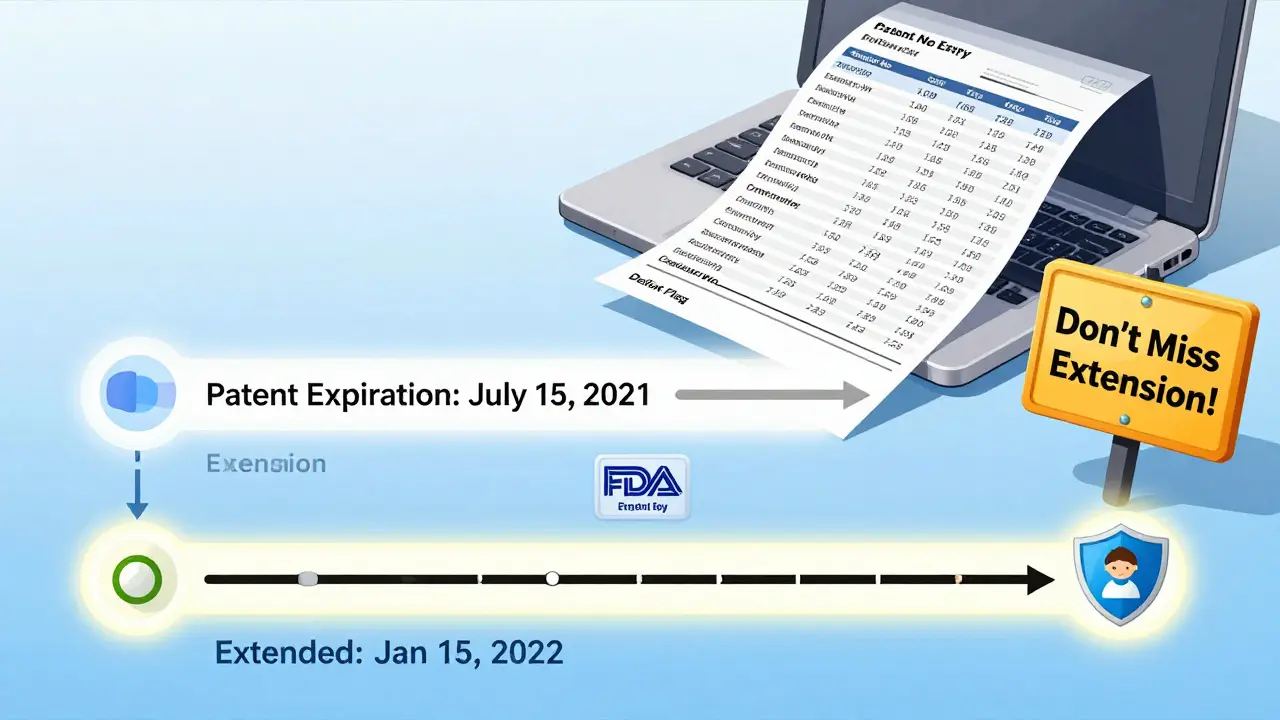
For instance, if a company did new clinical trials for a pediatric population, they get an extra 6 months of exclusivity. That 6 months gets tacked onto the end of every patent and exclusivity period for that drug. So you might see two lines for the same patent:
- Patent Expiration: July 15, 2021
- Patent Expiration: January 15, 2022 (with “Pediatric Exclusivity” noted)
This isn’t a mistake. It’s how the FDA shows that the protection was extended. If you’re looking at the expiration date and wondering why a generic hasn’t launched yet, check for this dual listing. You might be missing the 6-month extension.
How Accurate Is the Orange Book?
Here’s the hard truth: the Orange Book is a great starting point, but it’s not perfect. A 2023 study from the National Bureau of Economic Research (NBER) found that 46% of patents listed in the Orange Book expire early-meaning the patent owner stopped paying maintenance fees, and the patent died before the listed date. The Orange Book doesn’t update those dates retroactively. So if a patent expired in 2022 but wasn’t removed from the database, it might still show up as active in 2026.
Another issue: the Orange Book only lists patents that the brand-name company chooses to submit. If a company doesn’t submit a patent, it won’t appear-even if it’s valid. That means a generic manufacturer might think a drug is free to copy, only to get sued later because a patent was never listed.
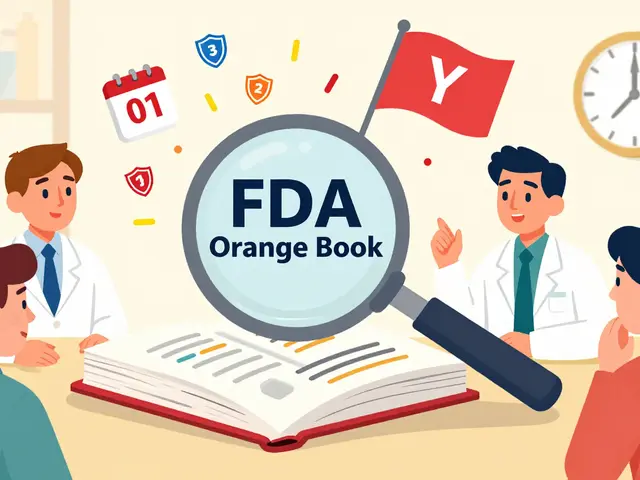
For critical decisions-like launching a generic drug-you should cross-check the Orange Book with the USPTO Patent Center database. The NBER study found that 89% of patent expiration dates matched between the two sources. But the remaining 11% had discrepancies. In those cases, the USPTO data was often more accurate.
How to Use the Data Files
If you’re doing serious research-say, analyzing market entry trends or building a database-you shouldn’t rely on the web interface. The FDA provides downloadable Orange Book Data Files updated daily. These are CSV files with structured columns:
- Product No
- Patent No
- Patent Expiration
- Drug Substance Flag
- Drug Product Flag
- Patent Use Code
- Delist Requested Flag
- Submission Date
These files let you filter by drug, sort by expiration date, and even track which patents were submitted after 2003 (the “Drug Substance Flag” tells you if the patent covers the active ingredient itself). You can automate this data into spreadsheets or databases. Many generic drug companies use these files to build their launch calendars.
What You Should Watch For
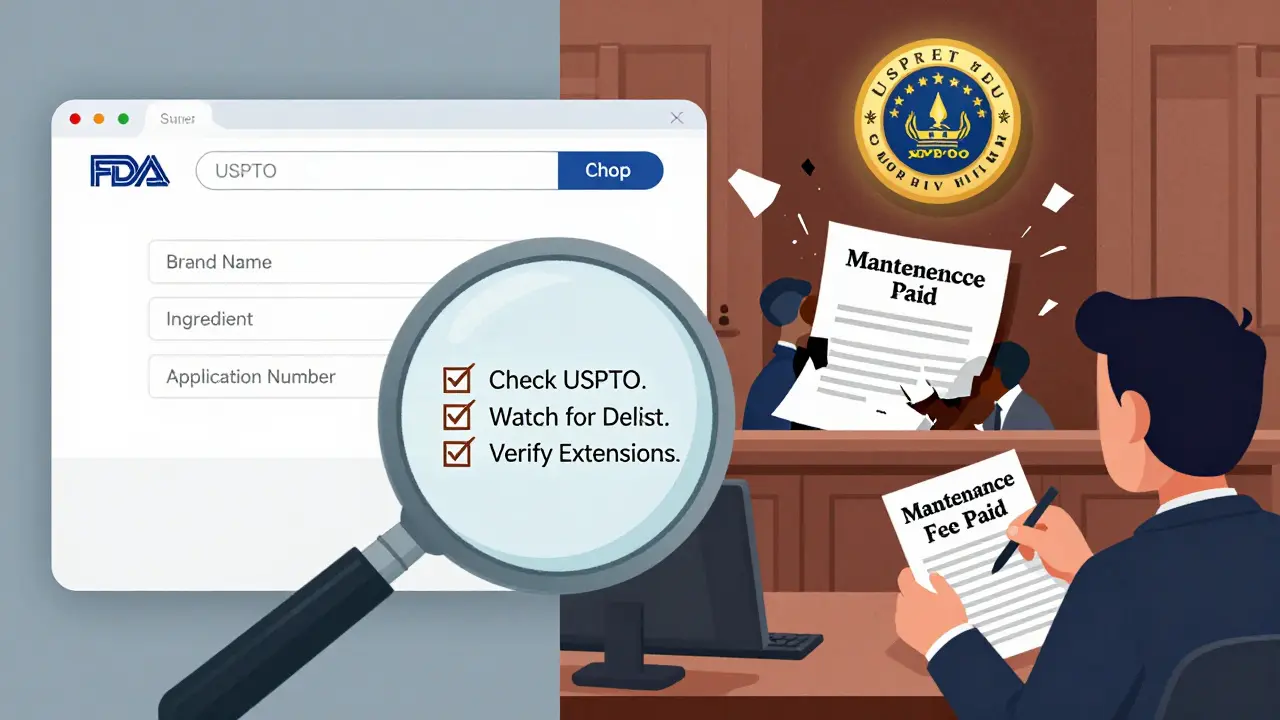
There are red flags that signal a patent might be about to fall off:
- Delist Request Flag = Y: The patent owner asked the FDA to remove the patent. This often happens after a legal challenge or if the patent is weak.
- No patent listed: Some drugs have no patents at all. That means generics can launch immediately after exclusivity ends-or even sooner.
- Exclusivity expires before patents: If a drug has 180-day exclusivity that ends in 2025, but patents last until 2028, generics still can’t launch until 2028. The exclusivity doesn’t override the patent.
Also, keep an eye on the FDA’s guidance updates. The Orange Book Transparency Act of 2020 forced the FDA to tighten rules on how and when patents must be listed or removed. Since then, the agency has been more aggressive about removing expired or invalid patents. But the system still lags behind real-world changes.
Why This Matters
By 2025, an estimated 78% of brand-name drug revenue will face generic competition. That’s billions of dollars in savings for patients and insurers. But that transition only happens if generics can enter the market on time. If patent expiration dates are misread, companies might launch too early and get sued-or too late and miss a market window.
For patients, this means knowing when a cheaper version might appear. For pharmacists, it means advising patients on when to expect lower prices. For policymakers, it’s about understanding how long monopolies last and whether they’re serving public health.
The Orange Book isn’t magic. It’s a tool. And like any tool, it works best when you understand its limits. Always check for delistings. Always look for pediatric extensions. Always cross-reference with the USPTO if you’re making high-stakes decisions. And remember: the date on the screen isn’t always the date the patent actually expires.
Where can I find the FDA Orange Book online?
The official Electronic Orange Book is hosted by the FDA at https://www.accessdata.fda.gov/scripts/cder/ob/index.cfm. You can search by drug name, active ingredient, or application number. For bulk data, download the daily-updated files from https://www.fda.gov/drugs/drug-approval-applications-das/orange-book-data-files.
Do all drugs have patent expiration dates listed in the Orange Book?
No. Only drugs with patents or exclusivity that have been properly submitted by the brand-name sponsor are listed. Some drugs have no patents at all. Others may have patents that were never submitted to the FDA. Biologics are not included in the Orange Book-they’re tracked separately under the Purple Book.
What’s the difference between a patent and exclusivity?
A patent is a legal right granted by the USPTO that gives the patent holder exclusive rights to make, use, or sell the invention-for up to 20 years from filing. Exclusivity is a regulatory period granted by the FDA that prevents other companies from submitting generic applications, even if there’s no patent. Exclusivity can last from 180 days to 7 years and is tied to specific FDA approvals, like new formulations or pediatric studies.
Why do some patents show two expiration dates in the Orange Book?
That’s usually because of pediatric exclusivity. When a drug sponsor conducts pediatric studies and gets a 6-month exclusivity extension, the FDA lists the original patent expiration date and then adds a second line with the extended date. The extension doesn’t create a new patent-it just adds time to all existing protections.
Can a patent expire before the date listed in the Orange Book?
Yes. Patents can expire early if the owner fails to pay maintenance fees to the USPTO. The FDA doesn’t retroactively update the Orange Book for these early expirations. So a patent listed as expiring in 2030 might have actually died in 2024. Always verify with the USPTO Patent Center if timing is critical.
How often is the Orange Book updated?
The web interface updates daily. The downloadable data files are also updated daily, reflecting new patent submissions, delistings, and expiration changes. However, the FDA doesn’t remove expired patents unless the sponsor requests it or the patent is invalidated by a court. So older data may still appear even if the patent is no longer active.
What’s the best way to plan for generic drug entry?
Start with the Orange Book to identify the latest patent or exclusivity expiration date. Then cross-check with the USPTO Patent Center for maintenance fee status. Monitor for any delisting requests. Look for pediatric exclusivity extensions. And track regulatory changes-like the 2020 Orange Book Transparency Act-that may affect how patents are listed. For commercial decisions, combine Orange Book data with legal and market analysis.
Comments
Okay but like… have you SEEN the Orange Book lately?? It’s a maze!! I spent three hours last week trying to track down a single patent expiration, and half the time it was just… gone?? Like, poof!! I swear the FDA updates it with a magic wand and a cup of coffee. I’m just here for the generics, not the drama!!
Let me tell you something-this isn’t just a database, it’s a battlefield. Every patent listed is a brick in a wall built to keep prices high. But the real story? The ones that disappear. The delistings. The ones that vanish before the clock runs out. That’s where the game is won. I’ve seen companies lose millions because they trusted the Orange Book without checking the USPTO. The system’s rigged, but if you know the loopholes? You can turn it into a ladder.
This is all fake. The FDA and big pharma are in cahoots. The Orange Book is a distraction. Real patent expirations are hidden in encrypted servers controlled by the WHO and the IMF. They want you to believe this is transparent. It’s not. They are delaying generics to keep you dependent. Wake up.
Can we just take a moment to appreciate how wild it is that a government database can literally change someone’s life? I have a friend with a rare condition who waited two years for a generic because of a misread patent date. When it finally dropped, the price fell by 90%. That’s not policy. That’s humanity. This tool matters. Even if it’s messy.
Look. I’ve built entire business models around this data. The Orange Book is your starting line-not the finish. I automate the CSV downloads, cross-reference with USPTO, flag delistings, and run weekly audits. If you’re not doing this, you’re flying blind. And yes, I’ve caught patents that expired two years ago still showing up. The FDA doesn’t care. You have to care more.
While I deeply appreciate the thoroughness of this exposition, I must respectfully note that the regulatory architecture underpinning the Orange Book remains, in its current iteration, insufficiently responsive to the exigencies of public health. The absence of real-time validation mechanisms, coupled with the discretionary nature of patent submissions, creates systemic vulnerabilities that disproportionately affect low-income populations. A more robust, auditable, and automated framework is not merely advisable-it is ethically imperative.
Interesting. But honestly? I don’t have time for this. I just check the price on GoodRx. If it’s cheap, I buy it. If not, I wait. The Orange Book? Sounds like a textbook for people who like spreadsheets. I’ll stick to my pharmacy.
You’re all missing the point. The Orange Book isn’t the enemy-it’s the map. The real victory is when someone like you or me learns how to read it. I teach this to new pharmacists every month. One girl cried because she realized her patient could save $800/month. That’s why we do this. Not for the patents. For the people.
Wrong. The Orange Book doesn’t list patents for drugs that are still under exclusivity. That’s not a flaw-it’s the whole system. You’re supposed to wait. The FDA isn’t hiding anything. You’re just mad because you want generics NOW. Patents exist for a reason. Stop being entitled.
I know what’s really going on. The Orange Book is a front. The real expiration dates are buried in encrypted blockchain ledgers controlled by pharmaceutical lobbyists. The FDA doesn’t update it because they’re being paid to lie. I’ve seen the emails. They’re all in a private Slack channel called "KeepThePriceHigh". You think this is about health? It’s about profit. And they’re laughing at us.
Patent expiration dates are not always accurate. Always verify with USPTO. Delistings matter. Pediatric extensions are critical. And yes-the system lags. That’s all.
Bro, I used to think this was boring. Then I found out my mom’s $1,200/month drug dropped to $40 because someone checked the Orange Book and caught a delisting. Now I run a bot that scrapes it every day. It’s not magic. It’s just data. And data wins.
Why does America even need this? In India, we get generics the moment the patent expires. No bureaucracy. No delays. No confusing tables. You overcomplicate everything. Just let people buy cheap medicine. Why are you making this so hard?