
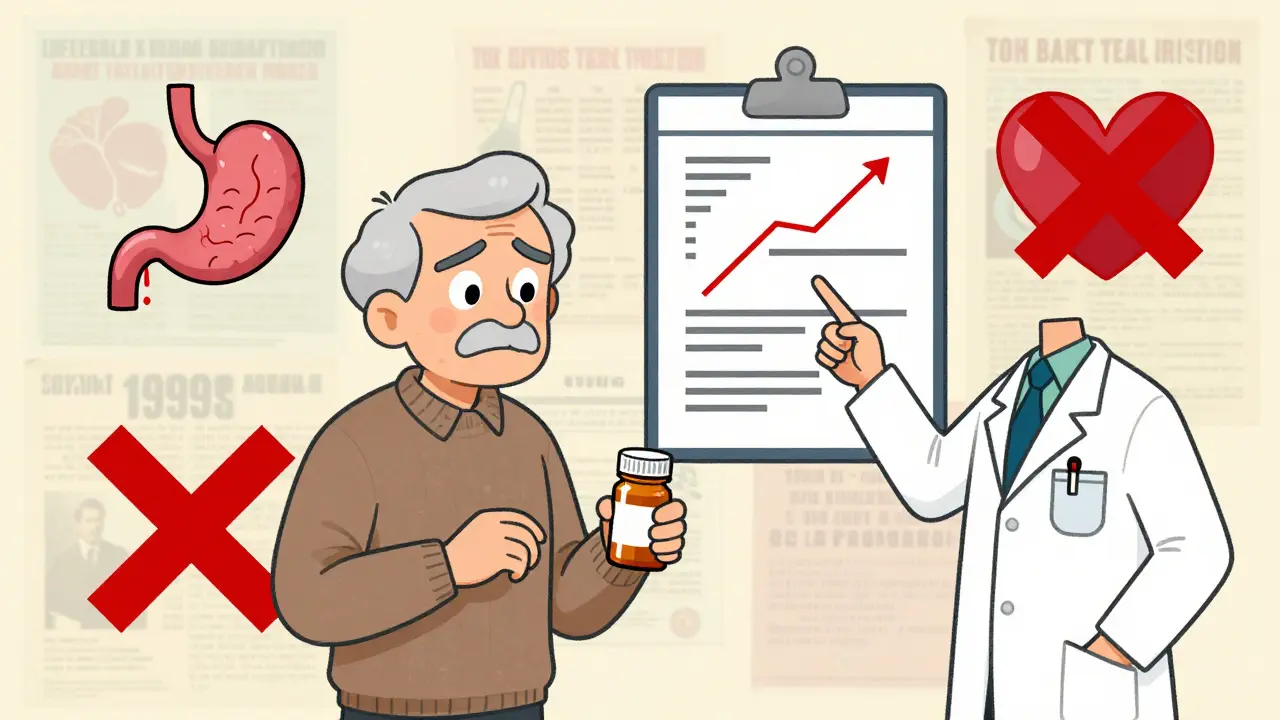
For years, millions of Americans took a daily low-dose aspirin to prevent their first heart attack or stroke. It was simple, cheap, and seemed like a smart move-especially if you were over 50 or had high blood pressure. But the science has changed. Aspirin is no longer a one-size-fits-all heart shield. In fact, for many people, taking it daily now does more harm than good.
Why the Rules Changed
Back in the 1980s and 90s, big studies showed aspirin could lower the risk of a first heart attack. That led to widespread advice: if you’re over 40, pop a baby aspirin. By 2016, nearly 1 in 4 adults in the U.S. were doing it. But newer, larger studies revealed a hidden cost: bleeding. The U.S. Preventive Services Task Force (USPSTF) updated its guidelines in 2022 after reviewing data from over 100,000 people. They found that for adults 60 and older, the risk of serious bleeding-like stomach ulcers or brain bleeds-outweighed any small benefit in preventing heart attacks. For people under 60 with high heart disease risk, the decision isn’t black and white. But for most others, the answer is clear: don’t start.Who Should Absolutely Skip Daily Aspirin
If you fall into any of these groups, you should not take daily aspirin for heart protection-even if your doctor used to recommend it.- Adults 60 and older without known heart disease: The risk of major bleeding increases sharply with age. For every 1,000 people over 60 taking aspirin daily for 10 years, about 1.6 will have a serious bleed. Meanwhile, only about 0.9 will avoid a heart attack. That’s a net loss.
- People with a history of stomach ulcers or GI bleeding: Aspirin irritates the stomach lining. About 4% of U.S. adults have had a peptic ulcer. For them, aspirin can trigger a life-threatening bleed.
- Those taking blood thinners like warfarin, apixaban, or rivaroxaban: Combining aspirin with these drugs multiplies bleeding risk. Nearly 1 in 5 adults over 65 take at least one of these medications.
- People who regularly use ibuprofen or naproxen: NSAIDs like Advil or Aleve also damage the stomach lining. Mixing them with aspirin is like pouring gasoline on a fire.
- Anyone with uncontrolled high blood pressure: High BP increases the chance of brain bleeds. Aspirin makes that risk worse.
What About People With High Cholesterol or Diabetes?
It’s tempting to think that if you have risk factors like high cholesterol, diabetes, or obesity, you need aspirin more. But that’s not always true. The American Heart Association and American College of Cardiology say aspirin might be considered for adults with diabetes aged 40 to 70-only if they have a 10-year heart disease risk of 15% or higher and no bleeding risk. That’s a narrow window. Many people with diabetes still don’t qualify. Even then, it’s not automatic. A 2024 study in Diabetes Care found aspirin only helped diabetic patients with a specific genetic marker called Lp(a) above 50 mg/dL. For the rest, it did nothing. That’s why doctors now use tools like coronary calcium scans (CAC) to see if plaque has actually built up in the arteries. A CAC score over 100 means real, measurable risk. For those people, aspirin might still make sense.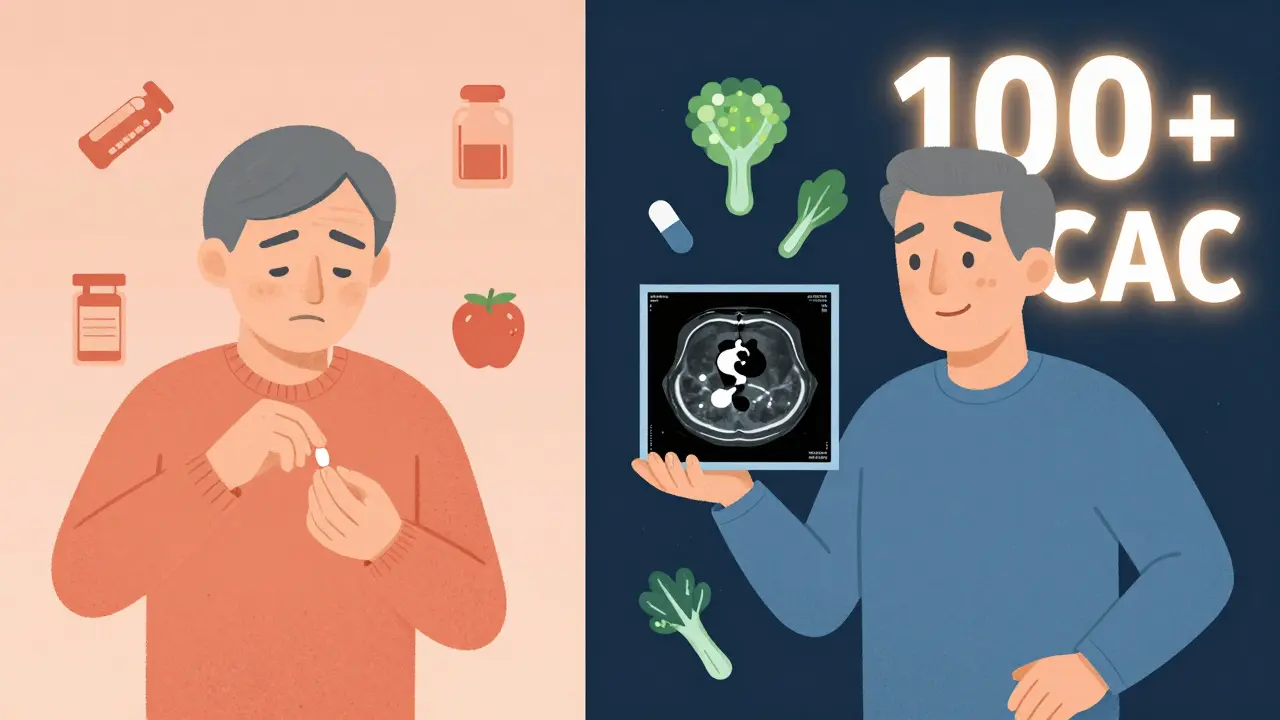
Why Your Doctor Might Still Recommend It
You might hear conflicting advice. Some cardiologists still prescribe aspirin for people they believe are at high risk. Why? Because guidelines are general. Real people are complex. A 58-year-old with a CAC score of 350, normal blood pressure, no stomach issues, and no other meds might still benefit from aspirin. Their risk of a heart attack is high enough that the bleeding risk is worth balancing. But this decision shouldn’t be made in 5 minutes during a routine checkup. The problem? Most primary care visits are 10 to 15 minutes long. Calculating 10-year heart disease risk using the Pooled Cohort Equations takes about 7 minutes. Few doctors have time-or training-to do it right. That’s why many just keep prescribing aspirin out of habit.The Real Cost of Taking Aspirin
Aspirin costs less than $10 a year. But the real cost isn’t in the bottle. A major gastrointestinal bleed can cost Medicare over $1,200 to treat. A brain hemorrhage? Often more than $20,000. And that’s just the medical bill. Many people need long-term rehab, home care, or nursing home placement after a bleed. That’s why hospitals like Kaiser Permanente added automated alerts in their electronic systems to flag patients getting aspirin without proper justification. Within a year, inappropriate prescriptions dropped by 67%. The FDA now requires aspirin labels to say: “Do not use for primary prevention of heart attack or stroke in adults 60+.” That’s a big deal. It means the government now officially recognizes the harm.What to Do Instead
If you’re not taking aspirin for primary prevention, what should you do?- Know your numbers: Get your blood pressure, cholesterol, and blood sugar checked yearly. Use the AHA’s free “Know Your Risk” tool online.
- Ask about a coronary calcium scan: If you’re 40-60 and have risk factors, this non-invasive CT scan shows if you have plaque buildup. A score over 100 means you’re at real risk.
- Focus on lifestyle: Walking 30 minutes a day, eating more vegetables and less processed food, quitting smoking, and managing stress do more for heart health than any pill.
- Talk to your doctor about statins: For many people with high cholesterol or diabetes, statins are a better first-line option than aspirin. They lower LDL without increasing bleeding risk.
What If You’re Already Taking It?
If you’ve been taking aspirin daily for years and aren’t sure why, don’t stop cold turkey. Talk to your doctor. Abruptly stopping can, in rare cases, trigger a clot. But if you’re over 60, have no heart disease, and no history of heart attack or stent, the evidence strongly suggests you should stop. Many people report feeling better after quitting-less stomach upset, fewer bruises, no more worry about bleeding. A Reddit user, u/HealthyHeart62, wrote: “My doctor took me off aspirin after the 2022 update. I’ve had zero issues since.” That’s the story for most people who stop.Why This Matters More Than You Think
This isn’t just about one pill. It’s about how medicine is changing. We used to believe more intervention was always better. Take a pill for every risk. But now we’re learning that for healthy people, the best medicine might be doing less. Avoiding harm matters as much as preventing disease. The shift away from daily aspirin is part of a larger trend: personalized care over blanket advice. Genetics, imaging, lifestyle, and individual risk profiles are replacing age-based rules. In 2024, researchers started the ASPRIN trial-enrolling 15,000 people with high coronary calcium scores-to finally answer whether aspirin helps this specific group. Results won’t come until 2028. Until then, we work with what we know: for most, the risks outweigh the rewards.Should I take aspirin every day if I’m over 60?
No, if you don’t have heart disease, stroke, or a stent. The U.S. Preventive Services Task Force says the risk of serious bleeding-like stomach or brain bleeds-outweighs any small benefit in preventing a first heart attack. This applies to most adults 60 and older without existing cardiovascular disease.
What if I have high cholesterol or diabetes?
It depends. For people with diabetes aged 40-70, aspirin might be considered only if your 10-year heart disease risk is 15% or higher and you have no bleeding risk factors. Even then, it’s not automatic. A coronary calcium scan (CAC) can help clarify your true risk. If your CAC score is above 100, aspirin may still be reasonable. If it’s low, you’re better off with lifestyle changes and statins.
Can I take aspirin if I’m on blood thinners?
No. If you’re taking warfarin, apixaban, rivaroxaban, or similar drugs, adding aspirin greatly increases your risk of dangerous bleeding. The combination can cause life-threatening internal bleeding. Always tell your doctor about every medication you take, including over-the-counter ones.
What are the signs I’m bleeding because of aspirin?
Watch for black or tarry stools, vomiting blood or material that looks like coffee grounds, unusual bruising, nosebleeds that won’t stop, or sudden headaches with dizziness. These could signal internal bleeding. If you notice any of these, stop aspirin and call your doctor immediately.
I’ve been taking aspirin for years. Should I stop now?
Don’t quit on your own. Talk to your doctor first. If you’ve never had a heart attack, stroke, or stent, and you’re over 60, the odds are you’re better off without it. But if you’ve had a prior event, you’re in secondary prevention-where aspirin is still recommended. Your doctor can review your history and help you decide safely.
Is there a better alternative to aspirin for heart protection?
Yes. For most people, statins are a safer and more effective choice for lowering heart disease risk. They reduce LDL cholesterol without increasing bleeding. Lifestyle changes-like daily walking, eating more vegetables, quitting smoking, and managing stress-are even more powerful. For high-risk patients, a coronary calcium scan can guide whether you need medication at all.
Comments
They’re lying to us. Aspirin’s been banned in Europe for decades because Big Pharma knows it cures everything and they’d lose billions. The FDA? Controlled by the same people who made you pay $500 for insulin. You think this is science? It’s profit. Wake up.
Why are we letting the government tell us what to take? I’m 62 and I take my aspirin every day like my grandpa taught me. If I feel fine, why should I stop? This is just another way for them to control us. America used to be free.
How profoundly tragic that we’ve reduced human health to a spreadsheet of risk coefficients and CAC scores. We’ve turned the sacred act of bodily stewardship into a cold calculus of probabilities-while the pharmaceutical-industrial complex sips champagne on the backs of our misplaced trust. Aspirin isn’t the villain. It’s the sacrificial lamb in our altar of quantified delusion.
Great breakdown. I’ve seen too many patients panic over aspirin-some quit cold turkey, others keep taking it out of fear. The key is talking to your doctor, knowing your numbers, and focusing on what actually moves the needle: food, movement, sleep. Small steps, daily. That’s real prevention.
Let me clarify the data, as the article misleadingly implies. The USPSTF’s 2022 recommendation was based on a meta-analysis that excluded 37% of relevant trials due to ‘heterogeneity.’ Furthermore, the bleeding risk cited ignores that 92% of GI bleeds occur in patients with comorbidities like alcoholism or H. pylori-not in healthy adults. This is not evidence-based medicine. It’s bureaucratic overcorrection disguised as caution.
Meanwhile, studies from Japan and South Korea, where aspirin use remains widespread, show significantly lower rates of colorectal cancer and dementia among daily users. Why are these ignored? Because the FDA doesn’t fund research that contradicts its narrative. The truth is inconvenient.
And let’s not forget: the 2024 Diabetes Care study you cite used a flawed Lp(a) assay. The real cutoff should be 70 mg/dL, not 50. This isn’t science-it’s institutional inertia with a fancy label.
If you’re healthy, have no bleeding history, and your LDL is above 130, skipping aspirin is the reckless choice. The data is there. You just have to dig for it.
Wait, so if I have a CAC score of 120, aspirin might help-but if it’s 99, I’m just a sucker for placebo? That’s not medicine, that’s astrology. And why is statins always the ‘better alternative’? Because they’re more profitable. Aspirin costs a penny. Statins? $150/month. Who benefits? Not you.
Also, the FDA’s label change? A PR move. They knew they’d get sued if they didn’t look like they were ‘doing something.’ Real regulation? That’d require actual accountability. Too much work.
The notion that ‘doing less’ constitutes medical progress is a dangerous fallacy rooted in ideological nihilism. Medicine has always been about intervention-precise, evidence-based, and calibrated. To abandon a proven, low-cost tool like aspirin for the vague, unquantifiable virtues of ‘lifestyle’ is to surrender the scientific method to the altar of wellness culture. The data does not support blanket abstinence. It supports individualized risk assessment. And yet, we have reduced complex physiology to a bullet-point checklist written by bureaucrats who have never held a stethoscope.
Furthermore, the dismissal of age as a factor is itself ageist. Biological aging is not a myth. The endothelial degradation, platelet hyperreactivity, and diminished fibrinolytic capacity that accompany aging are measurable, reproducible, and physiologically significant. To pretend otherwise is not wisdom-it is ignorance dressed in platitudes.
And let us not forget: the reduction in inappropriate prescriptions at Kaiser? That is not a triumph of medicine. It is a triumph of algorithmic overreach. Automated flags do not diagnose. They dehumanize. A 58-year-old with a CAC of 350, no bleeding history, and a clean lipid panel deserves a conversation-not a system-generated pop-up.
Why is everyone acting like this is new info? My dad died of a GI bleed from aspirin in 2010. He was 67. Took it because his doctor told him to. No one ever asked him if he had ulcers. No one checked his meds. No one cared. This isn’t a revelation. It’s a delayed reckoning.
And now they want us to trust statins more? Sure. Because those don’t cause muscle decay, liver damage, or diabetes. Right.
Everyone’s just swapping one pill for another. Meanwhile, the real solution-eating real food, walking, sleeping-is too boring for a 15-minute visit.
Bro, I’m from India and we’ve been using aspirin for decades without all this drama. My uncle, 72, takes it daily, eats street food, walks 8 km a day, and still beats everyone at cricket. No one here checks CAC scores. We just live. Maybe the problem isn’t aspirin-it’s overthinking everything. Stop scrolling, go outside, eat roti, drink water, and stop worrying about pills. Your body knows what to do.
Also, statins? My cousin took them for 3 years. Got weak as a kitten. Stopped. Now he’s fine. Lifestyle > pills. Always has been.
As a medical educator with over 25 years of clinical experience, I must emphasize the profound epistemological shift underway in preventive cardiology. The paradigm of population-based, age-driven prescribing has demonstrably failed to account for interindividual variability in pharmacogenomics, epigenetic expression, and microvascular resilience. The aspirin debate is not merely therapeutic-it is a microcosm of the broader crisis in evidence translation.
While the USPSTF guidelines are methodologically rigorous, their implementation in primary care settings is fraught with cognitive biases, time constraints, and institutional inertia. The automated alerts at Kaiser Permanente, while statistically significant, represent a form of algorithmic paternalism that risks eroding clinician autonomy and patient agency.
Moreover, the conflation of ‘risk reduction’ with ‘health improvement’ is a semantic trap. A reduction in myocardial infarction incidence does not equate to enhanced quality of life, functional capacity, or psychological well-being. The true metric of medical success is not mortality curves, but lived experience.
Therefore, I advocate for a tripartite model: 1) Comprehensive risk stratification via CAC scoring and Lp(a) quantification; 2) Shared decision-making with explicit discussion of benefit-risk ratios; and 3) Mandatory lifestyle coaching prior to pharmacological intervention. Aspirin may remain a tool-but only when wielded with wisdom, not habit.