

When a fungal infection turns serious-like candidemia in a hospital patient or invasive aspergillosis in someone with a weakened immune system-choosing the right antifungal isn’t just about effectiveness. It’s about safety, cost, and how the drug interacts with everything else the patient is taking. Two major classes of antifungals dominate modern treatment: azoles and echinocandins. They work in completely different ways, come with very different risks, and are used in very different situations.
How Azoles and Echinocandins Work
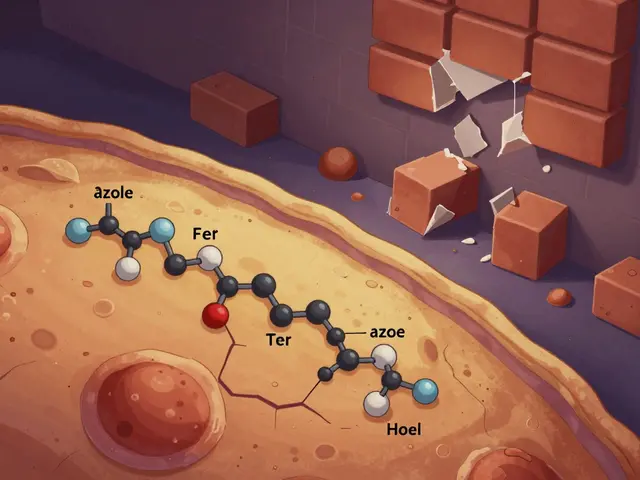
Azoles-like fluconazole, voriconazole, and posaconazole-attack the fungal cell membrane. They block an enzyme called lanosterol 14-alpha-demethylase. Without this enzyme, the fungus can’t make ergosterol, the main building block of its cell membrane. Think of it like removing the bricks from a wall. The membrane gets weak, leaky, and eventually falls apart.
Echinocandins-caspofungin, micafungin, and anidulafungin-go after the cell wall instead. They stop the fungus from making beta-(1,3)-D-glucan, a key structural component. Without it, the cell wall can’t hold together under pressure. The fungus literally bursts from the inside. It’s like cutting the steel beams out of a building.
That difference in target explains why azoles can be taken by mouth and echinocandins can’t. Azoles are small enough to be absorbed through the gut. Echinocandins are large molecules that get broken down if swallowed. That means echinocandins are only given through an IV, which limits where and how they’re used.
When Doctors Choose Azoles
Azoles are the workhorses of antifungal therapy. Fluconazole, for example, is used every day in outpatient clinics for yeast infections, thrush, and even to prevent fungal infections in people getting chemotherapy. It’s cheap, well-tolerated, and 90% of it gets absorbed when taken by mouth.
For more serious infections like invasive candidiasis, azoles are still first-line in many cases. A 2021 meta-analysis found fluconazole cured 82% of candidemia cases. But here’s the catch: it’s not always the safest choice.
Voriconazole is the gold standard for invasive aspergillosis. Studies show it cuts death rates nearly in half compared to older drugs like amphotericin B. But it comes with a cost. Nearly 40% of patients on voriconazole report temporary visual disturbances-blurred vision, color changes, light sensitivity. It’s not dangerous, but it’s unsettling. Patients often think they’re having a stroke.
And then there’s the drug interaction problem. Azoles block liver enzymes-CYP3A4 and CYP2C9-that break down a huge number of other medications. That means if you’re on an azole and also taking blood thinners, statins, seizure meds, or even some heart medications, levels of those drugs can spike dangerously high. A 2022 analysis found azoles have over 500 severe drug interactions. One doctor on Reddit reported three cases where voriconazole doubled phenytoin levels in epilepsy patients, forcing emergency dose reductions.
When Echinocandins Are the Better Option
Echinocandins aren’t used for every fungal infection. They don’t work well against some molds or cryptococcus. But for invasive candidiasis in critically ill patients-those in the ICU with sepsis-they’re the clear first choice.
Why? Because they’re safer for the kidneys and liver. In patients with organ failure, azoles can push already struggling organs over the edge. Echinocandins, on the other hand, have less than 2% risk of causing acute kidney injury, compared to over 8% with azoles. That’s why the Infectious Diseases Society of America (IDSA) recommends echinocandins as first-line for ICU patients with candidemia.
They also have far fewer drug interactions. Only about 180 severe interactions compared to over 500 for azoles. That makes them easier to manage in patients on complex medication regimens.
The downside? You need an IV. That means hospital stays, nursing time, and higher costs. A seven-day course of caspofungin runs about $1,250. Fluconazole? Around $150. That price difference matters in hospitals with tight budgets-and for patients without good insurance.

Safety Risks You Can’t Ignore
Both classes can hurt the liver. Azoles are the bigger offender. The FDA requires quarterly liver tests for anyone on long-term azole therapy. If liver enzymes rise more than five times the normal level, you stop the drug. Between 2018 and 2022, over 1,800 cases of azole-related liver damage were reported to the FDA. Ketoconazole was pulled from the U.S. market in 2013 because it caused liver failure in too many people.
Echinocandins are gentler on the liver, but not risk-free. Still, only about 287 liver injury reports were filed for them in the same period. That’s a big difference.
Another hidden risk: heart rhythm changes. Posaconazole and voriconazole can prolong the QT interval-the time it takes the heart to recharge between beats. If that gets too long, it can trigger a deadly arrhythmia. The European Committee on Infection Control issued a safety alert in 2023 after 37 cases of QT prolongation over 500ms were linked to posaconazole, especially when paired with macrolide antibiotics like azithromycin.
And don’t forget pregnancy. Azoles are classified as Pregnancy Category D-there’s clear evidence they can harm a developing fetus. Echinocandins are Category C-risk isn’t ruled out, but data is limited. In pregnant women with fungal infections, doctors often lean toward echinocandins when possible.
Monitoring and Practical Tips
If you’re on an azole, expect regular blood tests. Liver function every few weeks. For voriconazole and posaconazole, doctors may also check drug levels in your blood. Why? Because absorption varies wildly between people. One person might need 200mg daily, another might need 400mg just to get the same effect. Without monitoring, you’re either underdosed (risking treatment failure) or overdosed (risking toxicity).
Echinocandins don’t need blood level checks. But they do need careful IV management. Infusion reactions-fever, chills, flushing-are common, especially at the start of treatment. Nurses often slow the drip or give antihistamines to prevent them.
And here’s something many patients don’t know: avoid certain topical products. Clotrimazole-betamethasone dipropionate-a common cream for athlete’s foot or eczema-contains a steroid. Steroids can make fungal infections worse. That’s why dermatologists now warn against using steroid-antifungal combos unless absolutely necessary.

What’s Changing in the Antifungal World
Resistance is rising. In agricultural areas where triazole fungicides are sprayed on crops, Aspergillus fungi are learning to resist the same drugs used to treat people. Azole resistance in Aspergillus fumigatus jumped from 1.8% in 2012 to 8.4% in 2022. That’s a major red flag.
New drugs are coming. Rezafungin, a new echinocandin approved in March 2023, can be given once a week instead of daily. That’s a game-changer for hospital stays and outpatient care. Olorofim, a brand-new class of antifungal, showed promise in treating azole-resistant aspergillosis in Phase 3 trials. It’s not yet approved, but it could be the first new antifungal in over 20 years that works against resistant strains.
Big pharma is investing again. AstraZeneca bought Fusion Pharmaceuticals for $3.2 billion in 2023 to develop next-gen antifungals. That hasn’t happened in decades. The market is growing-not just because infections are increasing, but because we’re finally realizing how underfunded and overlooked fungal disease has been.
Choosing the Right Drug
There’s no one-size-fits-all answer. Here’s how doctors decide:
- For mild yeast infections: Fluconazole, oral, cheap, effective.
- For invasive candidiasis in ICU: Echinocandin-saves kidneys, fewer interactions.
- For invasive aspergillosis: Voriconazole-best survival rates, but watch for vision issues and drug interactions.
- For long-term prevention in transplant patients: Posaconazole or isavuconazole-better tissue penetration than fluconazole.
- For pregnant women: Avoid azoles if possible. Echinocandins preferred if systemic treatment is needed.
The bottom line? Azoles are versatile and convenient. But they’re a minefield of side effects and interactions. Echinocandins are more limited in use but far safer for the most vulnerable patients. The best choice isn’t about which drug is stronger-it’s about which one fits the patient’s whole picture: their organs, their other meds, their risk level, and their life outside the hospital.
Are azoles safe for long-term use?
Azoles can be used long-term, but they require close monitoring. Liver function tests are needed every 3 months. Long-term use increases the risk of liver damage, QT prolongation, and drug interactions. Fluconazole is generally the safest for extended use, while voriconazole and posaconazole carry higher risks and need blood level checks. Always discuss the risks with your doctor before starting long-term therapy.
Can I take echinocandins by mouth?
No. Echinocandins like caspofungin, micafungin, and anidulafungin cannot be taken orally because they’re broken down in the stomach and intestines. They must be given intravenously. Researchers are working on oral versions, but none are approved yet. For outpatient care, azoles are preferred when possible.
Why are echinocandins more expensive than azoles?
Echinocandins are complex molecules that require advanced manufacturing and sterile IV preparation. A seven-day course of caspofungin costs around $1,250, while fluconazole costs about $150. The higher cost reflects production complexity and limited competition. However, in critical care settings, their safety benefits often justify the cost by reducing hospital stays and complications.
Do antifungals interact with over-the-counter supplements?
Yes. Even common supplements like St. John’s wort, grapefruit juice, and high-dose vitamin E can interfere with azoles. Grapefruit juice, for example, can raise voriconazole levels by up to 50%, increasing toxicity risk. Always tell your doctor about every supplement you take-many patients don’t realize these count as medications.
What should I do if I miss a dose of my antifungal?
For oral azoles like fluconazole, take the missed dose as soon as you remember, unless it’s almost time for the next one. Don’t double up. For IV echinocandins, contact your care team immediately. Missing a dose can lead to treatment failure, especially in serious infections. Hospitals often have protocols for missed doses, including possible dose adjustments or extended infusions.
Can fungal infections come back after treatment?
Yes. Especially in people with weakened immune systems, fungal infections can recur. Azole resistance is increasing, making some infections harder to treat. Follow-up testing, like blood cultures or imaging, may be needed after treatment ends. If symptoms return, don’t assume it’s the same infection-resistance or a new strain could be involved.
Antifungal therapy is no longer just about killing the fungus. It’s about protecting the patient’s entire body-liver, heart, kidneys, and drug interactions-while fighting a silent, growing threat. The right choice depends on more than just the infection. It depends on the person.
Comments
Just had to say this after reading the part about voriconazole and vision stuff 😅 I thought I was going blind during my transplant recovery-turns out it was just the drug. My nurse laughed and said, 'Welcome to the club.' Took me three days to realize I wasn't having a stroke, just weird color filters. Still use it, but now I always ask if the visual stuff is normal. Thanks for the clarity!
Why are we even using these expensive IV drugs when fluconazole works fine? It’s just lazy medicine. People don’t want to take pills so they push IVs. Also, 'safety' is just a buzzword-azoles have been around for decades and no one died from them. Stop overcomplicating everything.
Thank you for this incredibly thorough breakdown. As a nurse in a rural hospital with limited pharmacy support, I’ve seen too many patients get stuck on azoles because they’re cheaper-and then end up with elevated LFTs or dangerous interactions with their antihypertensives. The echinocandin recommendation for ICU patients is spot on. We just don’t have the resources to monitor azole levels properly. I wish more outpatient docs understood how high-risk these drugs are long-term. Also, please note: 'liver enzymes' is misspelled as 'liver enxymes' in one spot-minor, but worth fixing for clarity.
It is, without question, a matter of profound concern that the medical community continues to prioritize convenience over clinical prudence. The indiscriminate use of azoles, particularly in non-critical settings, constitutes a dangerous precedent. The pharmacokinetic variability, coupled with the staggering number of drug interactions, renders these agents unsuitable for routine use outside of tightly controlled environments. The rise in resistance is not merely a statistical anomaly-it is the direct consequence of therapeutic negligence.
Biggest thing people miss: azoles aren’t bad-they’re just not for everyone. I’ve had patients on fluconazole for years with zero issues because they’re young, healthy, and on no other meds. But throw in a statin and a beta-blocker? Boom. Toxicity city. Echinocandins aren’t perfect, but they’re the safety net when things get messy. And yeah, the cost sucks-but so does a 7-day ICU stay from liver failure. This isn’t about which drug is better. It’s about matching the tool to the patient. If you’re not doing that, you’re not practicing medicine-you’re just prescribing.
Correction: The FDA does not require quarterly liver tests for all azoles-only for specific agents like ketoconazole and itraconazole under prolonged use. Fluconazole, in most cases, requires monitoring only if risk factors are present. This generalization misleads clinicians. Also, posaconazole’s QT prolongation risk is dose-dependent and typically occurs above 400 mg/day, not universally. Precision matters.
Why is no one talking about how azoles are destroying the microbiome? I’ve seen candida overgrowth in patients after long-term azole use-even after the infection is gone. It’s not just liver or heart-it’s gut chaos. And no one checks stool cultures or recommends probiotics. This is a systemic blind spot. We treat the fungus, then wonder why patients are bloated and exhausted for months. Fix the ecosystem, not just the pathogen.
Rezafungin once-weekly? YES. PLEASE. I work in a long-term care facility-we’ve got 12 residents on IV antifungals. Daily infusions are a nightmare: staffing, IV access, infection risk. If we can do one shot a week? Game-changer. Also, the grapefruit juice warning? I had a guy take his voriconazole with a glass of OJ and then ask why he was hallucinating. Turned out it was grapefruit juice he didn’t know was in the bottle. Don’t let patients guess. Just tell them: ‘No citrus. No grapefruit. No pomelo. No Seville oranges. Ever.’ And write it on the bottle.
The entire premise of this article is fundamentally flawed. Echinocandins are not 'safer'-they are merely less studied. The lower reported liver injury rates are a product of shorter exposure times and limited outpatient use, not inherent safety. Furthermore, the cost argument is economically illiterate: if a $1,250 drug prevents a $50,000 ICU admission, it is not expensive-it is cost-effective. The real issue is systemic underinvestment in antifungal research, not drug class superiority. Azoles are not the villain; neglect is.