
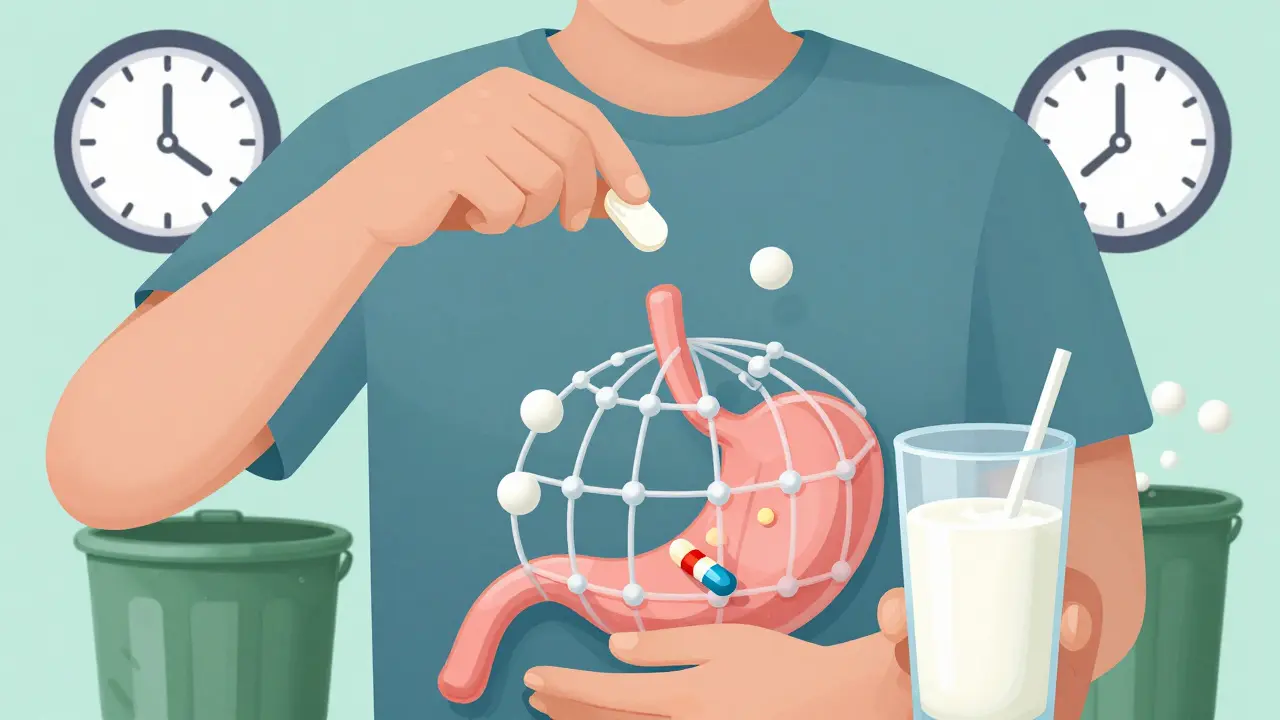
When you’re sick and taking antibiotics, the last thing you want is for your medicine to stop working - and yet, something as simple as a glass of milk or a spoonful of yogurt could be quietly sabotaging your treatment. It’s not a myth. It’s chemistry. And it’s happening more often than you think.
Why Dairy Messes With Antibiotics
Dairy products like milk, cheese, yogurt, and even calcium-fortified plant-based milks contain high levels of calcium, magnesium, and other minerals. These minerals don’t just sit there quietly. They latch onto certain antibiotics in your stomach and gut, forming tight chemical bonds called chelates. These chelates are too big and too stable to be absorbed through your intestinal wall. So instead of entering your bloodstream to fight infection, the antibiotic gets stuck - and eventually passes out of your body unused. This isn’t a minor issue. Studies show that when you take tetracycline or ciprofloxacin with dairy, your body absorbs as little as 8% of the dose. That’s not a 10% drop. That’s a 92% loss in effectiveness. A 2022 study in the Journal of Rawal Academy of Sciences found yogurt reduced ciprofloxacin absorption by 92%, while milk cut it by 70%. Even a small amount of dairy - like a splash in your coffee - can trigger this reaction.Which Antibiotics Are Affected?
Not all antibiotics are affected the same way. The big two classes that suffer the most are:- Tetracyclines: This group includes tetracycline, doxycycline, and minocycline. These are commonly prescribed for acne, Lyme disease, and respiratory infections. Tetracycline itself is the most sensitive - absorption can drop by up to 90% with dairy. Doxycycline is a bit more forgiving, but still needs separation.
- Fluoroquinolones: Ciprofloxacin (Cipro), levofloxacin (Levaquin), and moxifloxacin (Avelox) fall here. These are often used for urinary tract infections, sinus infections, and pneumonia. Even a single serving of yogurt can slash ciprofloxacin levels by over 70%.
Other drugs like bisphosphonates (used for osteoporosis) and some iron supplements behave the same way. But antibiotics like penicillin, amoxicillin, azithromycin, and clarithromycin? They’re fine with dairy. No interaction. No timing needed.
How Long Should You Wait?
Timing isn’t just a suggestion - it’s the only reliable fix. Here’s what the experts say:- For tetracyclines: Take the pill at least 1 hour before or 2 hours after eating or drinking anything with dairy. Some sources, like the European Association of Hospital Pharmacists, recommend waiting 3 hours for full safety.
- For fluoroquinolones like ciprofloxacin: Wait 2 hours before dairy, and 4 to 6 hours after. Why the longer wait? These drugs are absorbed quickly, but dairy sticks around longer in your gut. Waiting 4 hours ensures the calcium has moved on.
Let’s say you take your doxycycline at 8 a.m. and again at 8 p.m. That means no milk at breakfast, no cheese on your lunch sandwich, and no yogurt with your dinner. If you want dairy, aim for mid-morning (around 10 a.m.) or mid-afternoon (around 4 p.m.) - well outside your dosing window.
It’s not easy. Especially if you’re used to taking pills with breakfast. But skipping dairy for a few days while you’re on antibiotics is far easier than restarting your treatment because the infection didn’t clear.

It’s Not Just Milk
Many people think only cow’s milk is the problem. It’s not. Any product with added calcium can trigger the same reaction:- Almond milk, soy milk, oat milk - if it’s calcium-fortified, it’s risky.
- Calcium-fortified orange juice.
- Antacids or supplements with calcium, magnesium, or iron.
- Some cereals and protein bars with added minerals.
A 2023 study in the Journal of the American Pharmacists Association found that nearly 30% of patients who thought they were avoiding dairy were still taking calcium-fortified plant milks with their antibiotics. The result? Just as much interference as regular milk.
Always check the label. If it says “calcium added” or “rich in calcium,” assume it’s off-limits until you’ve waited the full separation time.
What Happens If You Don’t Wait?
You might not feel anything right away. That’s the danger. The infection might seem to improve - but only because the antibiotic is working at half-strength. Then it stalls. Symptoms return. You think the drug failed. You might even think you’re allergic.In reality, you’ve created the perfect conditions for antibiotic resistance. When bacteria are exposed to low doses of antibiotics, they don’t die. They adapt. They survive. And next time, the same drug won’t work at all.
Doctors at Johns Hopkins have documented multiple cases of recurring UTIs tied directly to patients taking ciprofloxacin with breakfast cereal fortified with calcium. One patient, a 68-year-old woman, had five UTIs in 18 months - each time, she was taking her antibiotic with her morning glass of calcium-fortified orange juice. Once she changed her routine, the infections stopped.
And it’s not just individuals. A 2023 study in the Journal of Antimicrobial Chemotherapy found that 22% of treatment failures for urinary tract infections were linked to improper timing with dairy or calcium supplements. That’s one in five cases that could have been avoided.
What About Newer Antibiotics?
Pharmaceutical companies know this is a problem. That’s why newer versions like Cipro XR (extended-release ciprofloxacin) were developed. They’re designed to release the drug slowly, reducing the chance of calcium interference. But here’s the catch: they cost over $200 for a full course, while generic ciprofloxacin costs under $16.There are also experimental tetracycline derivatives in clinical trials that resist calcium binding. But they’re still years away from being available. Until then, timing remains the only proven method.

Real Stories, Real Consequences
On Reddit, a nurse shared a case where a patient on doxycycline for Lyme disease kept having flare-ups - until they realized she was drinking milk with every dose. Once she switched to taking it two hours before breakfast, her symptoms cleared in days. A Drugs.com user wrote: “My UTI kept coming back. My pharmacist told me to wait four hours after my cipro before having yogurt. I did it. Two days later, the burning stopped. I didn’t even need a second prescription.”These aren’t rare. A 2022 survey by the American Society of Health-System Pharmacists found that 43% of patients given tetracyclines or fluoroquinolones received no clear instructions about dairy. That’s almost half the people being prescribed these drugs - left to guess.
How to Get It Right
Here’s a simple plan:- Check your prescription. Is it a tetracycline or fluoroquinolone? If yes, proceed.
- Read the label. Look for “take on empty stomach” or “avoid dairy.”
- Plan your meals. Take your pill first thing in the morning - then wait two hours before eating anything with calcium.
- Use your evening dose as a reset. Take it at bedtime, and don’t eat dairy after dinner.
- Keep a list of calcium-rich foods and drinks handy. Check labels on plant milks, cereals, and supplements.
- Set phone reminders. Apps like Medisafe now flag dairy interactions automatically.
If you’re on a twice-daily schedule, try taking your antibiotic at 7 a.m. and 7 p.m. That gives you a 5-hour window around each dose to avoid dairy. You can still have milk at 10 a.m. and 4 p.m. - just not with your pill.
The Bigger Picture
This isn’t just about your personal health. It’s part of a global crisis. The World Health Organization estimates that poor antibiotic use - including timing errors like this - contributes to 5-10% of antibiotic resistance cases in community settings. Every time an antibiotic doesn’t work because of a missed timing window, we’re one step closer to a world where common infections become deadly again.Thankfully, awareness is rising. The FDA now requires clearer warnings on packaging. Pharmacies are training staff to explain timing in plain language. Digital tools are helping patients track their doses and avoid mistakes.
But the biggest change still comes from you. Knowing when to take your medicine is just as important as knowing what to take. And sometimes, the thing that helps you heal is the thing you stop doing - not the thing you start.
Can I drink milk with doxycycline if I wait a few hours?
No - you need to wait at least 2 hours after taking doxycycline before having milk or any dairy product. Even though doxycycline is less affected than older tetracyclines, calcium still binds to it and reduces absorption. Waiting 2 hours ensures your body gets the full dose.
What if I accidentally took my antibiotic with yogurt?
If it was a one-time mistake, don’t panic. Skip dairy for the rest of your course and take your next dose on an empty stomach. Don’t double up on your next pill - that can cause side effects. Just get back on schedule. If you’re worried your infection isn’t improving, contact your doctor.
Is almond milk safe with antibiotics?
Only if it’s not fortified with calcium. Many almond, soy, and oat milks have added calcium to mimic dairy. Always check the nutrition label. If it says “calcium carbonate” or “calcium phosphate” in the ingredients, treat it like regular milk - wait 2 to 6 hours after taking your antibiotic.
Do all antibiotics interact with dairy?
No. Only tetracyclines (like doxycycline) and fluoroquinolones (like ciprofloxacin) are strongly affected. Antibiotics like amoxicillin, azithromycin, penicillin, and clindamycin don’t interact with dairy. Always check your prescription label or ask your pharmacist.
How do I know if my antibiotic is affected?
Look for the drug class on your prescription: if it’s tetracycline, doxycycline, minocycline, ciprofloxacin, levofloxacin, or moxifloxacin - you need to time it. If it’s amoxicillin, azithromycin, or penicillin - dairy is fine. When in doubt, ask your pharmacist. They’re trained to catch these interactions.
Can I take calcium supplements with my antibiotic?
No. Calcium supplements - whether tablets, chewables, or liquids - will interfere just like dairy. Wait at least 2 hours after taking your antibiotic before taking any calcium, magnesium, or iron supplement. The same rule applies to antacids containing aluminum or magnesium.
Comments
Just took my doxycycline with my almond milk latte. Guess I’m restarting this course.
Let me tell you, this isn’t just some footnote in a drug leaflet - this is a silent, biochemical betrayal happening in your gut every single time you think ‘oh, it’s just a splash’ - and then your infection comes back like a horror movie sequel, and you’re left wondering why the hell your body won’t listen, and the truth? It’s not your immune system failing - it’s your coffee with almond milk that’s sabotaging you, and no one told you because no one thinks about calcium ions binding to antibiotics like they’re villainous little molecular handcuffs - and now you’re on your third UTI and your pharmacist just shrugged and said ‘maybe try not eating’ - like that’s a solution, not a life hack you should’ve been handed with your prescription.
lol i took cipro with yogurt once. now i have a new hobby: reading medical journals on my phone at 2am.
Thank you so much for this post - seriously - I’ve been on doxycycline for three weeks now, and I had no idea that fortified oat milk was the problem. I thought it was ‘plant-based’ so it was safe. My pharmacist just smiled and said, ‘You’re not alone.’ I cried. I didn’t even know I was crying until I looked up and saw my cat staring at me like I’d lost my mind. But now I’m timing it right - and my acne is finally clearing. I just wish more people knew this.
So you’re telling me my ‘healthy’ breakfast smoothie with calcium-fortified soy milk and a protein bar was basically pouring antibiotic-killing potion into my body? Classic. I’m not mad, I’m just disappointed in the food industry. Also, I’m now keeping a list of ‘dairy-adjacent traitors’ on my fridge. #CalciumIsTheNewVillain
Thank you for sharing this so clearly. I’m from India, and here, many people take antibiotics with tea and milk without thinking - it’s just how we’ve always done it. This post helped me explain to my mom why she shouldn’t give my brother milk with his cipro. Small changes, big impact. I’m sharing this with my whole family now.
Ah, yes - the grand tragedy of molecular chelation: a poetic, almost Shakespearean betrayal, wherein the very sustenance we consume to nourish our corporeal vessels becomes the instrument of our pharmaceutical undoing… a metaphysical irony wrapped in lactose and calcium phosphate. One must ask: are we victims of pharmacology… or victims of our own bourgeois breakfast rituals?
OMG I just realized I’ve been taking my azithromycin with my almond milk and I thought it was fine because it’s ‘plant based’ - wait no, azithromycin’s fine right? right?? I’m so confused now. Someone tell me I didn’t ruin my sinus infection.
Excellent summary. The data is clear, the timing guidelines are well-established, and the consequences of non-compliance are clinically significant. I recommend all patients on tetracyclines or fluoroquinolones receive written instructions and a visual timeline. Many pharmacies now offer these as printed handouts - a simple step that improves adherence and outcomes.
You know what’s wild? This whole thing reminds me of how we treat our bodies like machines we can just plug and play with - but we’re not robots. We’re living, messy, coffee-and-yogurt-eating humans. Maybe the real fix isn’t just timing - it’s learning to slow down, read the label, and care enough to do it right. I’m not perfect, but I’m trying. And that’s enough for today.