

Recall Check Tool
Find Your Lot Number
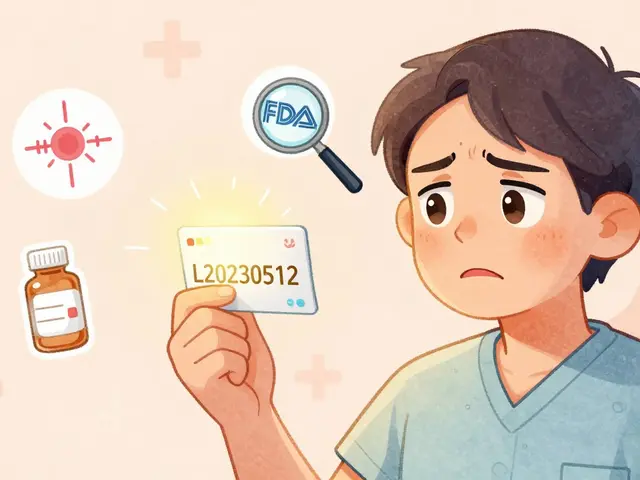
Check your implant card, surgical report, or medication packaging for a unique alphanumeric code like "L20230512" or "AB5X2021". This is not the same as a serial number.
Enter your lot number and click "Check Recall Status" to see if it's part of any recalls.
When you get a medical implant or take a prescription drug, you probably don’t think about the tiny code printed on the packaging or your implant card. But that lot number could save your life.
Every batch of medicine, every pacemaker, every hip replacement has a unique lot number. It’s not just a random string of letters and numbers. It’s a digital fingerprint that tells manufacturers exactly when and where your specific device or drug was made. And if something goes wrong - if a batch turns out to be defective, contaminated, or unsafe - that number is how doctors and regulators find you.
Here’s the hard truth: most patients have no idea how to check if their device or medication is part of a recall. In 2022, the FDA found that 68% of people with implanted devices couldn’t find their implant card when asked. Another 42% didn’t know how to look up recalls at all. That’s not just inconvenient - it’s dangerous.
Why Lot Numbers Matter More Than You Think
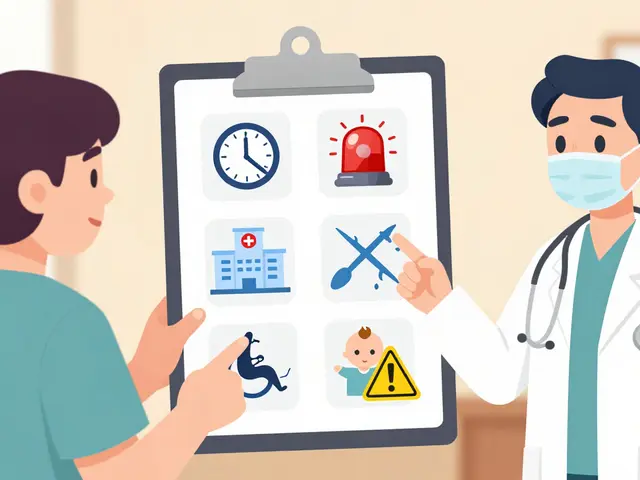
Not all recalls are created equal. The FDA classifies them into three levels:
- Class I: The most serious. These involve devices or drugs that could cause serious injury or death. About 12% of all medical device recalls fall into this category.
- Class II: Problems that might cause temporary health issues or minor harm. These are often fixable.
- Class III: The least risky. These are unlikely to cause harm but still need to be tracked.
In 2023 alone, there were 6,782 medical device recalls in the U.S. That’s nearly 18 per day. Most of these weren’t blanket recalls covering every unit ever made. They targeted specific lots - sometimes just a few hundred devices. Without the lot number, you’d be stuck guessing whether you’re affected.
Take the 2021 recall of Sapien 3 Ultra heart valves. Edwards Lifesciences had to pull 2,807 specific units out of circulation. Without lot tracking, they’d have had to notify hundreds of thousands of patients - most of whom were perfectly safe. That’s not just wasteful. It causes panic, delays care, and drains healthcare resources.
What’s on Your Implant Card? (And Where Is It?)
If you’ve had surgery, you were probably given an implant identification card. It should have:
- The name of the device (e.g., “Zimmer Biomet Persona Knee”)
- The model number
- The serial number or lot number
- The manufacturer’s contact info
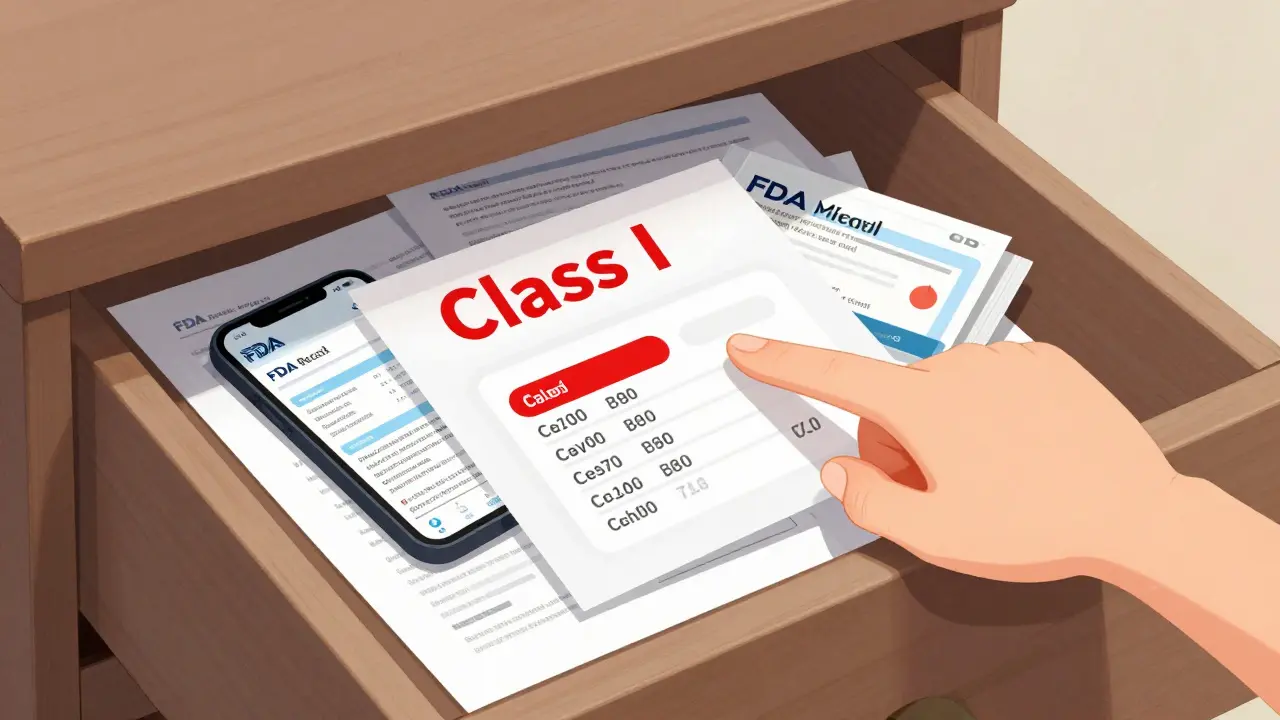
But here’s the problem: most people lose it. Or throw it away. Or leave it in a drawer somewhere and forget about it.
Don’t. Keep that card. Photograph it. Save it on your phone. Print it and stick it in a medical file with your other important papers - your insurance card, your surgeon’s contact info, your medication list. Treat it like your passport.
Experts say patients who keep this info on hand respond to recalls 72 hours faster on average. That might not sound like much, but in a medical emergency, those hours matter.
How to Check for Recalls - Step by Step
Here’s what you need to do - and it takes less than 10 minutes.
- Find your lot number. Look at your implant card, surgical report, or the packaging from your medication. Lot numbers usually look like L20230512 or AB5X2021. Don’t confuse them with serial numbers - they’re different.
- Go to the FDA’s Medical Device Recalls database. Visit fda.gov/medical-devices/safety/medical-device-recalls. Use the search bar to enter your device name or lot number. You can also filter by recall class.
- Check for drug recalls separately. For medications, go to fda.gov/drugs/drug-safety-and-availability/drug-recalls. Enter the drug name or lot number.
- Sign up for FDA email alerts. Go to fda.gov/medwatch and subscribe to the MedWatch program. You’ll get automatic notifications when recalls are issued that match your registered devices or medications.
- Register your device with the manufacturer. Most companies let you register your implant online. It’s free. It takes two minutes. And it means they can contact you directly if something goes wrong.
Pro tip: Set a calendar reminder to check the FDA site every three months. Recalls don’t happen often, but when they do, you need to know fast.
What If Your Doctor’s Office Doesn’t Track It?
You might assume your surgeon or clinic is keeping track of your lot number. But they’re not always doing it right. A 2023 study found that only 67% of orthopedic clinics consistently logged lot numbers into their electronic records. Cardiac device clinics? That number jumps to 98%. Why? Because heart devices carry higher risk - and regulators demand tighter tracking.
Don’t wait for your doctor to notify you. Even if your clinic says they’ll call, take responsibility. Ask your surgeon’s office for a copy of your operative report. It should list the lot number of your implant. If they don’t have it, ask them to check with the hospital’s supply chain department. They’re required to keep those records.
And if you’re getting a new device? Ask the nurse or surgeon: “Can you scan the barcode and make sure the lot number is in my record?” Most hospitals now use barcode scanners at the time of implantation. But not all. If they don’t, insist. Your safety is worth it.
The New Tools Coming - And How to Use Them
Things are getting better. In January 2024, the FDA launched a pilot program where you can text your lot number to 311-FDA and get an instant recall status reply. It’s still in testing, but it’s coming.
Electronic health records (EHRs) like Epic and Cerner now automatically show device lot numbers in patient portals - if your doctor’s office has updated their system. As of early 2024, 87% of major health systems have this feature. Log into your patient portal and look for a section labeled “Implants” or “Medical Devices.” If you see your lot number there, you’re set.
Some companies like Medtronic and Johnson & Johnson are testing blockchain systems that let you verify your device’s history through a mobile app. These aren’t widely available yet, but they’re the future.
And here’s the biggest change coming: by 2026, AI systems will automatically cross-check your medical record with recall databases. If your device is recalled, you’ll get a notification before you even know something’s wrong. But until then - you’re still the first line of defense.

What to Do If You Find a Recall
If you discover your device or medication is part of a recall, don’t panic. Don’t stop taking your medicine or remove your implant unless a doctor tells you to.
Instead:
- Call the manufacturer’s recall hotline (it’s on the FDA page).
- Call your doctor or surgeon. Ask what steps you need to take.
- Don’t throw away the device or packaging. You might need it for proof or replacement.
- Keep a log of all your calls - dates, names, what was said.
Some recalls require a simple replacement. Others need monitoring. A few require surgery. The FDA’s recall notice will tell you exactly what to do. Follow it.
Why So Many Patients Miss Recalls
It’s not your fault. The system is confusing.
Lot numbers aren’t designed for patients. They’re designed for warehouses and regulators. A lot number like “L20230105” might mean January 5, 2023 - but you won’t know that unless someone explains it. In FDA testing, 43% of patients couldn’t tell a real lot number from a fake one.
Manufacturers also don’t always reach patients directly. In 57% of negative reviews about recalls, people complained they never got a call, email, or letter. That’s because manufacturers often only notify the hospital or pharmacy - not the end user.
That’s why your personal tracking matters more than ever.
Final Checklist: Your Patient Safety Plan
Here’s your simple, no-excuses action plan:
- Find your implant card or medication packaging.
- Photograph the lot number and save it in your phone’s photos folder labeled “Medical Devices.”
- Create a digital or paper file with your surgical reports, device manuals, and implant cards.
- Register your device with the manufacturer (if possible).
- Sign up for FDA MedWatch email alerts.
- Check the FDA recall database every 3 months.
- Ask your doctor: “Is my lot number in my record?”
This isn’t about being paranoid. It’s about being prepared. You wouldn’t drive a car without checking the brakes. Don’t live with a medical device without knowing its history.
The system is improving. But until it works perfectly for everyone - you’re the most important part of it.
What is a lot number on a medical device?
A lot number is a unique code assigned to a specific batch of a medical device or medication. It helps manufacturers and regulators track exactly which units were made when and where. If a safety issue arises, this number allows them to recall only the affected products - not every unit ever made.
How do I find my lot number?
Check your implant identification card, surgical report, or the original packaging of your medication. The lot number is usually printed near the barcode or serial number. If you can’t find it, contact your surgeon’s office or pharmacy - they should have a record.
Do I need to register my medical device?
Yes, if the manufacturer offers registration. It’s free and takes less than two minutes. Registration ensures the company can contact you directly if your specific device is recalled. Not all devices can be registered, but most heart, joint, and insulin pump implants can.
What should I do if I think my device is recalled?
Don’t remove or stop using the device unless your doctor tells you to. First, confirm the recall by checking the FDA website. Then call the manufacturer’s recall hotline and your healthcare provider. Keep all packaging and documentation - you may need them for replacement or compensation.
Can I get a notification if my device is recalled?
Yes. Sign up for FDA MedWatch email alerts at fda.gov/medwatch. You can also text your lot number to 311-FDA (if available in your area). Some manufacturers also send alerts if you’ve registered your device. But don’t rely on them alone - check the FDA site yourself every few months.
Comments
Just found out my knee replacement’s lot number was in a Class II recall last year. I had no idea. Thanks for this breakdown - I screenshot the FDA page and saved it in my phone’s medical folder. Don’t know how I missed this before.
This is so important. I work in patient advocacy and see too many people panic when they hear ‘recall’ - then find out they’re not even affected. Teaching folks to check their lot numbers is like giving them a superpower. Seriously, share this with your grandma. Or your uncle who thinks ‘the doctor knows everything.’
from india here - we dont have much awareness but i saved this post. my mom had a hip implant last year and i just checked her card - lot number was there! gonna register it tonight. thanks for making it simple.
I cried reading this. My dad had a pacemaker implanted and the hospital never gave him a card. He’s 78 and terrified he’ll get sick and no one will know what’s inside him. I’m printing this out and taking it to his next appointment. You just gave me a way to help him.
It’s weird how we trust machines more than our own memory. We’ll remember the password to a streaming app but lose a card that could save our life. Maybe the real problem isn’t the system - it’s that we’ve outsourced our responsibility to institutions that don’t care enough to follow up. This post is a quiet rebellion against that.
Big +1 on the blockchain pilot. Medtronic’s app lets you verify your device’s chain of custody - it’s like a digital birth certificate for your implant. Not available everywhere yet, but if your surgeon’s office uses Epic and you’re in a major metro, ask if they’ve enabled the device registry module. It’s under ‘Patient Portal > Implants.’
Of course you didn’t know your lot number. You probably didn’t even read the 87-page consent form they handed you before surgery. People think medicine is like Amazon - ‘order, receive, forget.’ It’s not. This isn’t a ‘you should’ve known’ situation - it’s a systemic failure that’s been enabled by patient apathy. And now you’re mad because someone told you the truth?
Why don’t doctors just call us? It’s their job to keep us safe. I shouldn’t have to be my own detective. This is ridiculous.
LOL. You think the FDA gives a damn about you? They’re just trying to cover their own asses. I’ve seen recalls happen and nobody gets notified until six months later. And the manufacturers? They bury the bad data. This whole system is a scam. Don’t believe any of this.
While I appreciate the earnestness of this post, I must respectfully submit that the burden of vigilance placed upon the layperson in the context of an increasingly complex medical-industrial complex is both ethically problematic and structurally inequitable. Many individuals lack digital literacy, access to reliable internet, or the cognitive bandwidth to manage such tasks after enduring chronic illness. While the procedural steps outlined are technically sound, they presume a level of privilege - temporal, financial, and educational - that is not universally available. Perhaps the onus should shift from the patient to the institution that profited from the device’s deployment.
For anyone using an insulin pump or cardiac monitor: download the manufacturer’s app. Mine sends automatic alerts if my lot number is flagged. I also linked it to my Apple Health - now my emergency card has a QR code that pulls up my device info. Took 5 minutes. Life-changing.
Just got a reply from my surgeon’s office - they scanned my implant at the time of surgery and it’s in my record. I didn’t even know they did that. I’m going to ask everyone I know to do the same. This is the kind of info you don’t think about until it’s too late.