

Antidepressant Tapering Calculator
Create Your Personalized Tapering Schedule
Select your medication type and enter your current dose to generate a safe, step-by-step tapering plan
Why Tapering Antidepressants Matters
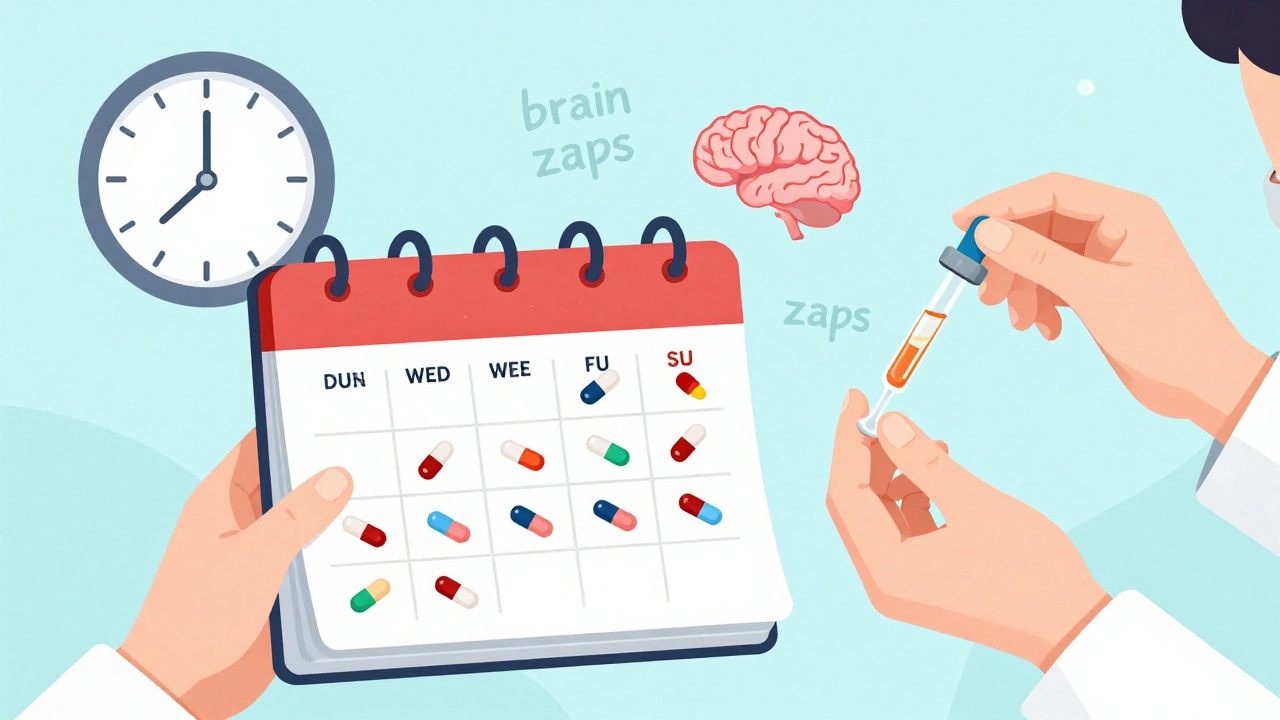
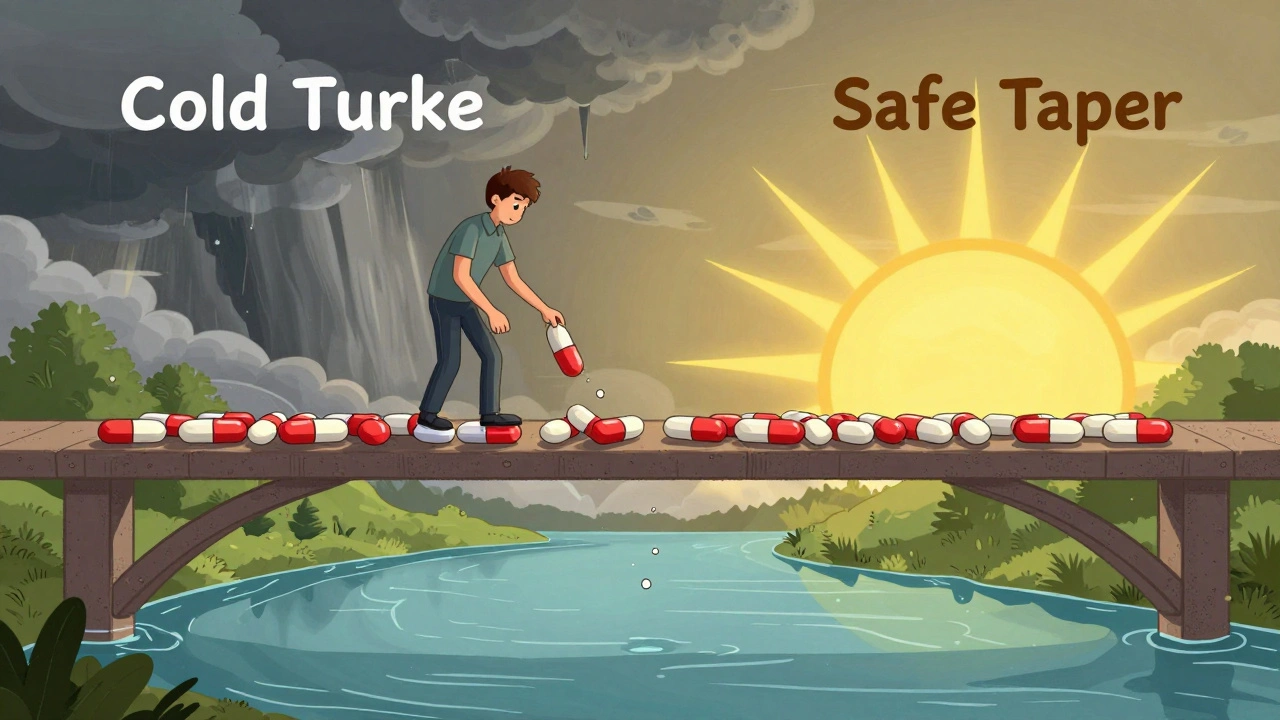
Stopping antidepressants suddenly can trigger a range of uncomfortable, sometimes frightening symptoms. Dizziness, brain zaps, nausea, insomnia, and flu-like feelings aren’t signs of relapse-they’re signs of withdrawal. This is called antidepressant discontinuation syndrome, and it affects between 27% and 86% of people who quit cold turkey. The risk isn’t just about discomfort. People who stop too fast are more likely to see their depression return. One Harvard study found that those who quit over just a few days had a 32% chance of relapsing within six months. Those who tapered slowly over two weeks or more cut that risk nearly in half.
The key isn’t just reducing the dose. It’s doing it slowly enough for your brain to adjust. Antidepressants change how your brain handles serotonin, norepinephrine, and other chemicals. When you remove them quickly, your brain doesn’t have time to rebalance. That’s why a structured taper isn’t optional-it’s essential.
How Fast Should You Taper?
There’s no one-size-fits-all timeline. But most experts agree on a basic rule: reduce your dose by 10% to 25% every 1 to 4 weeks. The exact speed depends on the drug you’re taking. Medications with short half-lives-like paroxetine, sertraline, and venlafaxine-leave your system quickly. That means your brain feels the drop faster, and symptoms hit harder. For these, slower is better. A 10% reduction every 2 to 4 weeks is often safer.
Fluoxetine is different. It has a long half-life thanks to its active metabolite, which sticks around for days. That’s why some people can stop fluoxetine more quickly without major issues. But even then, a gradual drop is still recommended. The last 10% of your dose? That’s where most symptoms happen. Dr. David Healy calls it the ‘last 10% problem’-the final bit of medication causes half the withdrawal symptoms because your brain’s receptors are hypersensitive at low doses.
For most people, a minimum of 4 weeks is needed to taper safely. Many need 2 to 6 months, especially if they’ve been on the medication for years. Rushing through the final stages is the most common mistake. Reducing by 5mg one week, then 5mg again the next, might seem fine-but for some, even a 2.5mg drop can trigger brain zaps or severe anxiety.
What to Expect During Withdrawal
Withdrawal symptoms usually start within a few days of reducing your dose. They peak around day 3 to 5 and fade within 1 to 2 weeks if you hold steady. Common signs include:
- Dizziness or lightheadedness (reported in 63% of cases)
- Electric shock sensations in the head or neck (‘brain zaps’)
- Nausea, vomiting, or stomach cramps
- Flu-like symptoms: fatigue, chills, muscle aches
- Sleep problems: vivid dreams, insomnia, or excessive sleepiness
- Anxiety, irritability, or mood swings
- Sensory changes: ringing in the ears, sensitivity to light or sound
Here’s the catch: many people mistake these symptoms for depression coming back. That’s why 73% of patients who feel awful during tapering go right back on their medication-even when they’re not depressed. Tracking your mood daily helps. If your sadness, hopelessness, or loss of interest stays stable or improves while you’re getting dizzy or having brain zaps, you’re likely experiencing withdrawal-not relapse.
Best Tapering Methods for Different Antidepressants
Not all antidepressants are the same. Your tapering plan needs to match your drug’s pharmacology.
For SSRIs (sertraline, escitalopram, citalopram, paroxetine)
These are the most commonly prescribed. Paroxetine has the shortest half-life and causes the most withdrawal. Here’s a practical example from NSW Therapeutic Advisory Group:
- Start: 20mg citalopram daily
- Week 1-2: Reduce to 15mg
- Week 3-4: Reduce to 10mg
- Week 5-6: Reduce to 5mg
- Week 7-8: Stop
For sertraline, some patients need to go even slower. A 25mg reduction might be too much. Try 12.5mg drops every 3 weeks instead. If you’re on 50mg, go to 37.5mg, then 25mg, then 12.5mg, then stop.
For SNRIs (venlafaxine, desvenlafaxine)
Venlafaxine is notorious for withdrawal. Its half-life is just 13 hours. Many people need to switch to a liquid form or use compounded capsules to make tiny reductions. A common approach:
- Reduce by 37.5mg every 3-7 days
- Once you hit 75mg, switch to 37.5mg reductions
- At 37.5mg, drop by 18.75mg every 10-14 days
- Final 9.375mg doses may require liquid formulation
For fluoxetine
Because it lingers in your system, you can taper faster. Still, don’t skip the process:
- Start: 40mg daily
- Week 1-2: Reduce to 20mg
- Week 3-4: Reduce to 10mg
- Week 5-6: Stop
Even with fluoxetine, skipping steps increases relapse risk.
For MAOIs (phenelzine, tranylcypromine)
These require a 14- to 21-day washout before starting any other antidepressant. Never switch directly. Serotonin syndrome-a dangerous, potentially fatal reaction-can occur if you overlap these drugs. Always consult a psychiatrist before making any changes.
When to Use Cross-Tapering
Switching from one antidepressant to another? Cross-tapering can help. This means slowly lowering the old drug while slowly raising the new one. It’s especially useful if your current medication isn’t working or is causing side effects.
Example: Switching from venlafaxine to sertraline
- Week 1: Reduce venlafaxine by 37.5mg, start sertraline at 25mg
- Week 2: Reduce venlafaxine by another 37.5mg, increase sertraline to 50mg
- Week 3: Stop venlafaxine, continue sertraline at 50mg
- Then taper sertraline slowly as above
This method avoids the ‘dip’ in serotonin that happens when you stop one drug before starting another. But it’s complex. Only do this under medical supervision.
Advanced Tools: Liquid Formulations and Micro-Tapers
Standard tablets make small reductions hard. A 10mg pill can’t be split into 2.5mg doses accurately. That’s where liquid formulations come in. King’s College London found that using liquid sertraline or fluoxetine allowed 1mg drops-and cut severe withdrawal symptoms by 62%.
Micro-tapering is another breakthrough. Instead of cutting 10% every two weeks, you cut 5% every 1-2 weeks, especially in the final stages. This is especially helpful if you’ve had bad withdrawal before. The TRED guideline (2022) recommends this for anyone who’s struggled with tapering in the past.
Pharmacogenetic testing is starting to help too. If you’re a slow metabolizer of CYP2D6 or CYP2C19 enzymes, your body clears antidepressants slower. That means you might need a longer taper. Early studies show this testing predicts 38% of withdrawal severity.
What Not to Do
Don’t stop because you feel ‘fine.’ Many people think if they’re not depressed, they don’t need the drug anymore. But your brain still needs time to adjust.
Don’t rely on vague advice like ‘go slow.’ You need numbers: exact doses, exact timelines.
Don’t taper during major life stress. If you’re going through a breakup, job loss, or family crisis, delay your taper. Your brain is already under pressure.
Don’t skip follow-ups. Check in with your doctor every 2-4 weeks. If symptoms get worse, pause the taper. Hold your dose for another 2 weeks before trying again.
When to Seek Help
Some withdrawal symptoms are normal. Others are warning signs. Call your doctor if you experience:
- Severe confusion or disorientation
- Hallucinations or paranoia
- Thoughts of self-harm or suicide
- Heart palpitations or chest pain
- High fever or seizures
These are rare, but they can happen. Don’t wait. Get help immediately.
Final Thoughts
Tapering isn’t about speed. It’s about safety. The goal isn’t to get off the drug as fast as possible-it’s to get off without wrecking your nervous system or triggering a relapse. Most people need months, not weeks. Use precise reductions. Track your symptoms. Use liquid formulations if needed. And never do this alone.
There’s no shame in needing time. Antidepressants change your brain chemistry. Giving your body the space to heal isn’t weakness-it’s wisdom.
How long does antidepressant withdrawal last?
Withdrawal symptoms usually start within 1-3 days of reducing your dose and last 1-2 weeks if you hold steady. For some, especially those on short-half-life drugs or tapering too fast, symptoms can last 4-8 weeks. In rare cases, people report symptoms for months-but this is uncommon and often linked to extremely rapid tapering or prior withdrawal episodes. If symptoms last longer than 8 weeks, consult your doctor to rule out other causes.
Can I stop antidepressants without tapering?
It’s not recommended. Stopping suddenly increases your risk of severe withdrawal symptoms by up to 3 times. Even with fluoxetine, which has a long half-life, abrupt discontinuation can cause dizziness, nausea, and mood swings. The only exception is if your doctor advises a direct switch to another medication with a similar profile. Even then, it’s not truly ‘stopping’-it’s replacing one drug with another under supervision.
Why do some people have worse withdrawal than others?
Several factors play a role. The type of antidepressant matters-paroxetine causes more withdrawal than fluoxetine. How long you’ve been on the drug also matters: people on antidepressants for 5+ years often have longer, more intense symptoms. Genetics play a part too. If your body metabolizes the drug slowly due to CYP2D6 or CYP2C19 gene variants, you’re more likely to have severe withdrawal. Past withdrawal episodes also increase your risk. And stress, sleep, and nutrition can make symptoms worse.
Should I use liquid antidepressants for tapering?
If you’re having trouble with small dose reductions or experiencing strong withdrawal symptoms, yes. Liquid formulations allow precise 1mg drops that tablets can’t provide. This is especially helpful for sertraline, fluoxetine, and venlafaxine. Many pharmacies can compound liquids or you can ask your doctor for a prescription. King’s College London research showed a 62% drop in severe symptoms when patients used liquid formulations instead of splitting tablets.
What if my symptoms come back after stopping?
It’s important to tell the difference between withdrawal and relapse. Withdrawal symptoms usually appear within days of a dose drop and improve within 1-2 weeks. Relapse symptoms-like persistent sadness, loss of interest, hopelessness, or trouble functioning-develop slowly over weeks or months. If you’re unsure, track your mood daily. If your symptoms return after being gone for 2+ weeks, it’s likely relapse. In that case, talk to your doctor about restarting the medication or trying a different approach. Don’t assume it’s withdrawal if it’s been more than a month since your last dose.
Comments
Tapering slow is key. I did 10% every 3 weeks. Brain zaps vanished. No relapse. Done.
I’ve been on sertraline for 7 years and tried to quit cold turkey once-big mistake. Ended up in the ER with dizziness and heart palpitations. Since then, I’ve learned the hard way that this isn’t like quitting caffeine. Your brain rewires itself around these drugs, and yanking them out fast is like pulling a keystone out of an arch. I used liquid sertraline and dropped 1mg every 10 days for the last 10mg. Took 4 months total. Felt like a slow motion rescue mission for my nervous system. People who say ‘just go slow’ don’t get it-you need a spreadsheet, not a gut feeling. And if you’re on venlafaxine? Forget tablets. Get the liquid or compounded capsules. Otherwise you’re just gambling with your mental stability.
This is the most helpful thing I’ve read all year. I’m from Texas and thought I was weak for needing so long to taper. Turns out my brain just needed time. No shame in that. Thank you for writing this. 🙏
I can’t believe people still think this is ‘just in their head’!! You’re messing with neurochemistry-this isn’t yoga or detox tea! Paroxetine? That’s a grenade with a 3-day fuse. And if you think splitting pills is ‘fine,’ you’re either a pharmacist or dangerously naive. I had to get my venlafaxine compounded into 3.75mg doses because my doctor was too lazy to help. Who the hell says ‘go slow’ without giving numbers?! This post should be mandatory reading for every GP in America.
I tried to taper after 5 years on citalopram... and I lost 3 weeks of my life to brain zaps and crying in the shower. I thought I was getting better, but it was just withdrawal. I tracked my mood like a scientist-no more guessing. And yes, the last 10%? Pure hell. I cried when I finally stopped. Not because I was sad... because I was free. But I almost didn’t make it. Please, if you’re reading this: don’t rush. You’re worth the time. 💔
Ugh another ‘tapering guide’ from the mental health cult. Everyone knows you just stop. Your brain adapts. Stop being a baby. I quit Lexapro in 3 days and I’m fine. Your problems are your mindset.
I appreciate how detailed this is. I’ve been on antidepressants for 12 years and have tried to quit twice-both times I relapsed within weeks. This time, I’m using the 5% micro-taper with liquid fluoxetine. I’m 8 weeks in and only had mild fatigue. I didn’t know about the ‘last 10% problem’ until now. Thank you for explaining that. I feel less alone.
In Nigeria, most people just stop. Doctors don’t know this stuff. I had to read this in English because my local psychiatrist said ‘it’s not real.’ I’m 3 months into tapering venlafaxine with compounded capsules. My cousin thinks I’m crazy. But I’m alive. And I remember what peace feels like.
This post is fire!! I used to think tapering was for weaklings but now I get it. I did the 10% every 2 weeks with sertraline and had 2 weeks of brain zaps at 5mg. But I held on. Now I’m off and my anxiety is lower than it’s been in 8 years. PS: liquid is the only way. Don’t be cheap with your brain.