
Medication Guide Knowledge Quiz
How Well Do You Know Medication Guides?
Test your knowledge about these essential patient safety tools
Which of these statements best describes a Medication Guide?
What percentage of patients actually read Medication Guides thoroughly?
What is the key benefit of reading your Medication Guide?
What should you do if you don't receive a Medication Guide with your prescription?
For what reason are Medication Guides required for certain drugs?
Your Results
You scored 0
Correct Answer: B
Medication Guides explain serious risks and what to watch for. The label on your bottle only shows dosage instructions, not the important safety information.
Correct Answer: C
Only 38% of patients read their Medication Guides thoroughly. Many patients don't realize the importance of this information.
Correct Answer: C
Patients who read their guides are 52% more likely to recognize warning signs and act on them. This is critical for preventing serious complications.
Correct Answer: C
If you don't receive a guide, contact your pharmacist immediately. They should provide you with one, or direct you to download it from the FDA website.
Correct Answer: C
Medication Guides are required only when a drug has serious risks patients need to understand. This is why they're not required for every medication.
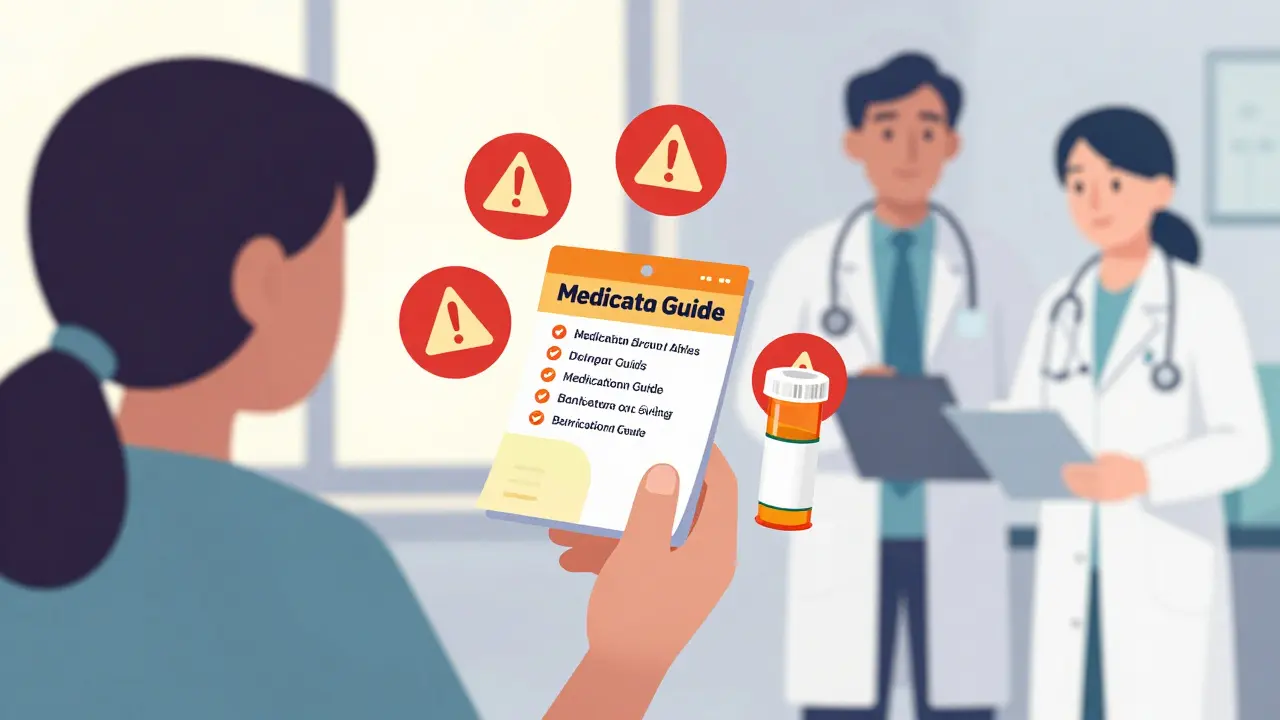
When you pick up a prescription, you probably grab the bottle, check the label, and head out. But tucked inside that bag, right next to your pills, is something just as important - a small booklet called a Medication Guide. It’s not just extra paper. It’s a lifeline. The U.S. Food and Drug Administration (FDA) requires these guides for certain prescription drugs because they carry serious risks that patients need to understand - risks that could mean the difference between staying safe and ending up in the hospital.
What Exactly Is a Medication Guide?
A Medication Guide is a printed handout that comes with specific prescription medications. It’s not the same as the small label on your pill bottle. That label tells you how much to take and when. The Medication Guide tells you what could go wrong - and how to avoid it.
The FDA doesn’t require these guides for every drug. Only about 150 out of thousands of prescription medications need them. But these aren’t random choices. They’re drugs with known, serious dangers - like blood clots, liver damage, suicidal thoughts, or rare but deadly infections. Think opioids, biologics for autoimmune diseases, certain antidepressants, and cancer treatments. If a drug has risks that patients might not fully understand, the FDA steps in and demands a guide.
These guides aren’t written by doctors or pharmacists alone. They’re created by drug companies, but they go through strict FDA review. Every word is checked. The language must be clear - no medical jargon. The FDA requires it to be written at or below a sixth-grade reading level. That means short sentences, simple words, and bold headings. No confusing paragraphs. No hidden warnings.
What’s Inside a Medication Guide?
It’s not just a list of side effects. A real Medication Guide includes specific, non-negotiable sections:
- Brand and generic names - so you know exactly what you’re taking.
- Approved uses - what the drug is officially meant to treat.
- Serious risks - the big dangers, written in bold, with clear descriptions.
- What to watch for - symptoms that mean you need to call your doctor right away.
- Drug interactions - which other medications, foods, or supplements to avoid.
- Contraindications - who shouldn’t take it at all (like pregnant women or people with certain allergies).
- Storage and disposal - how to keep it safe and throw it out properly.
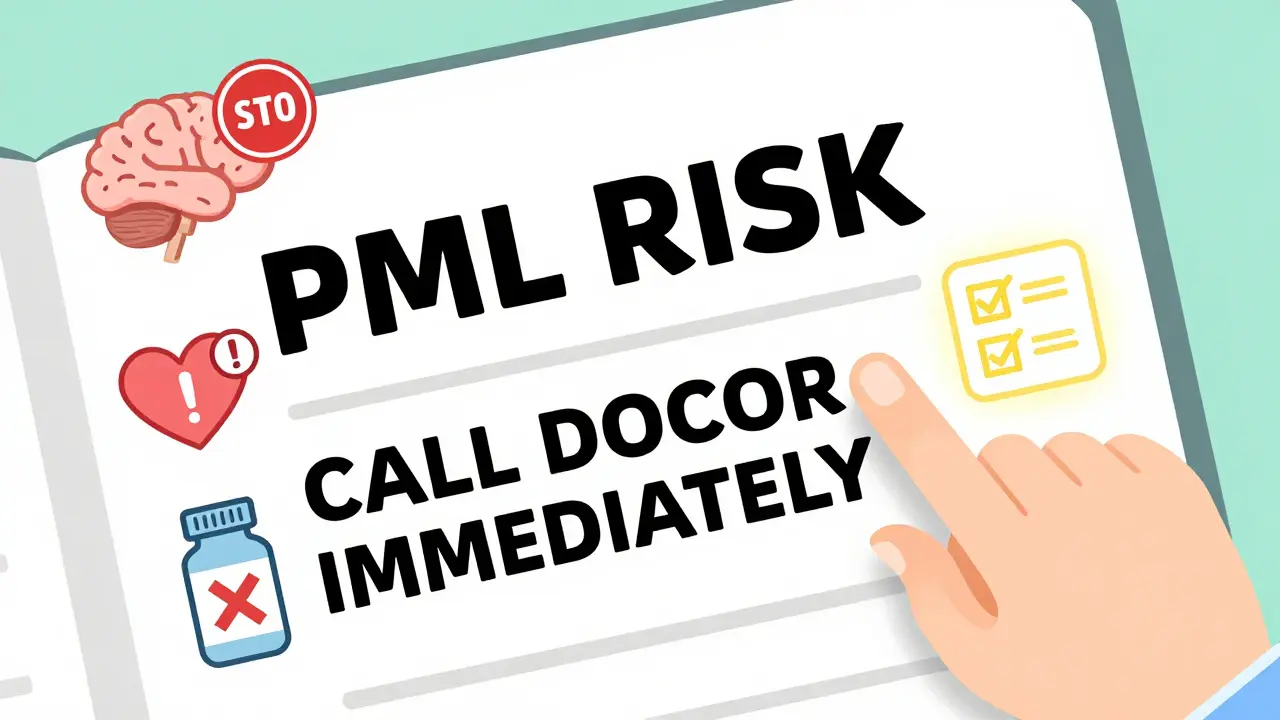
Compare that to a standard pharmacy label. It says: "Take one tablet by mouth daily." That’s it. The Medication Guide says: "This drug can cause a rare brain infection called PML. Early signs include vision changes, weakness on one side, and trouble speaking. If you notice any of these, stop taking it and call your doctor immediately."
That’s the difference between a reminder and a warning.
Why You Need to Read It - Even If You Think You Don’t
You’ve probably seen it. You’ve probably tossed it in a drawer without looking. You think, "I already talked to my pharmacist." Or, "My doctor explained everything." Or, "It’s too long. I don’t have time."
Here’s the truth: Only 38% of patients who received a Medication Guide actually read it thoroughly. That’s not because people are careless. It’s because many guides are dense, hard to scan, and don’t stand out.
But here’s what you might not realize: Patients who read their guides are 52% more likely to recognize warning signs and act on them. A 2022 study found that people who understood their Medication Guide were far more likely to notice early symptoms of serious side effects - and get help before it was too late.
One patient on PatientsLikeMe shared how her Tysabri Medication Guide saved her life. She noticed blurry vision and numbness - symptoms listed in the guide as early signs of PML. She called her doctor right away. Tests confirmed the infection. She stopped the drug. She avoided permanent brain damage. That guide didn’t just inform her. It gave her power.
How Pharmacists Are Trying to Make It Work
Pharmacists know these guides matter. But they’re stretched thin. On average, they spend less than a minute per prescription explaining the guide. Many say they rarely have time to go over it properly.
Still, the best practices are clear:
- Don’t just hand it over. Say: "This is important. Let me go over the top three things you need to watch for."
- Use the "teach-back" method: "Can you tell me in your own words what to do if you get sudden weakness?"
- Point to the bold sections. Highlight the red flags.
When pharmacists spend just 2-3 minutes discussing the guide, patient understanding jumps dramatically. It’s not about reading the whole thing. It’s about making sure you know the two or three things that could save your life.
What’s Changing - And What’s Coming
The system isn’t perfect. But it’s getting better.
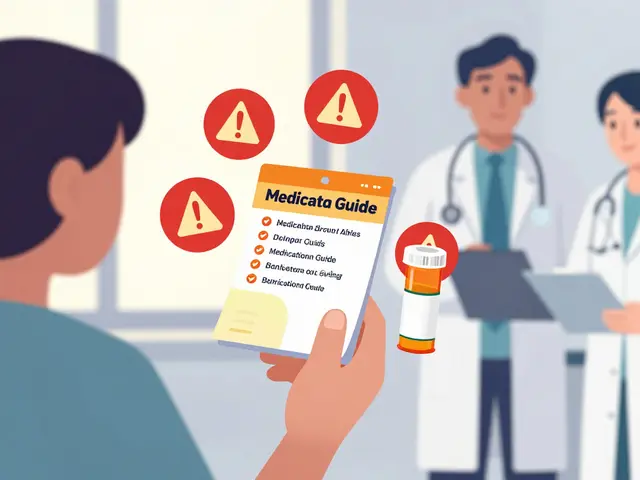
In 2023, the FDA approved the first Interactive Medication Guide for the diabetes drug Jardiance. It includes a QR code. Scan it with your phone, and you get a short video explaining risks, a personalized checklist, and even a way to download a printable version. This isn’t science fiction - it’s here now.
The FDA’s 2023-2025 plan includes major upgrades:
- Standardized visual risk icons - like warning triangles or red stop signs - to make danger obvious at a glance.
- Multilingual versions in the top 25 non-English languages spoken in the U.S.
- Integration with electronic health records - so your doctor’s system reminds your pharmacist: "This patient needs a guide. Don’t skip it."
And here’s the kicker: a 2023 study in The Lancet found that Medication Guides were linked to a 19.3% drop in serious adverse events for the drugs they covered. That’s not a small number. That’s thousands of hospitalizations avoided every year.
What to Do Right Now
If you’re taking a prescription drug, here’s what to do:
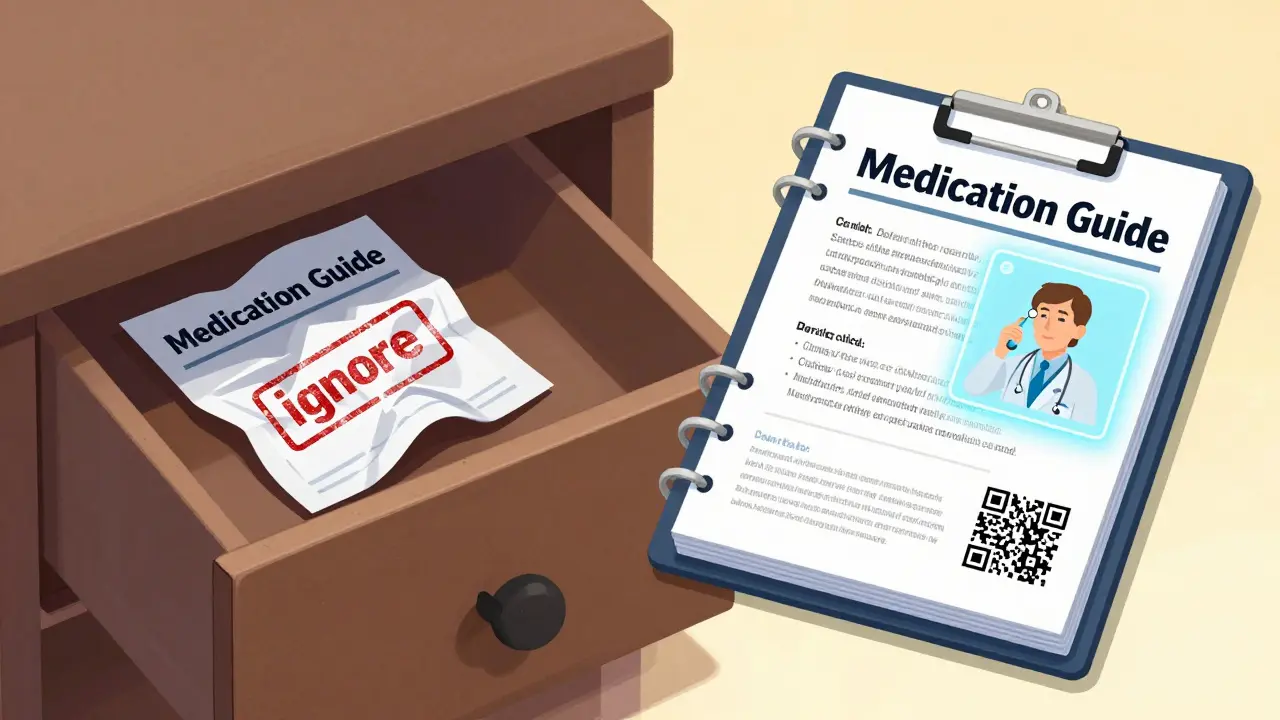
- Check your bag. Is there a small booklet with "Medication Guide" at the top? If yes, don’t ignore it.
- Look for bold text. That’s where the serious risks are.
- Ask your pharmacist: "What’s the one thing I should call you about right away?"
- Keep the guide. Don’t toss it. Put it with your other important health papers.
- If you’re on a high-risk drug (opioids, biologics, psychiatric meds), ask if you can get the digital version. Many pharmacies now offer it.
You don’t need to memorize every page. But you need to know the red flags. That’s all it takes.
Why This Matters
Medication errors are one of the top causes of preventable harm in U.S. healthcare. Many of them happen because patients don’t understand the risks. The Medication Guide isn’t bureaucracy. It’s not red tape. It’s a tool - designed by scientists, tested by regulators, and required because lives depend on it.
It’s not perfect. But it’s the best tool we have right now to make sure you know what you’re taking - and what to do if something goes wrong.
Are Medication Guides required for every prescription?
No. Only about 150 prescription drugs in the U.S. require a Medication Guide. These are typically drugs with serious risks - like opioids, biologics, psychiatric medications, and certain cancer treatments. The FDA only mandates them when the benefits are outweighed by serious safety concerns that patients need to understand.
Can I get a Medication Guide electronically instead of paper?
Yes. Since late 2022, the FDA allows electronic delivery of Medication Guides if the patient requests it. Many pharmacies now offer digital versions via email, text, or a secure patient portal. Some even include interactive videos and risk-check tools. Ask your pharmacist if this option is available.
What if I don’t receive a Medication Guide with my prescription?
If you’re taking a drug that requires a Medication Guide and you don’t get one, contact your pharmacist immediately. Manufacturers are required to supply them, and pharmacies must distribute them with every fill - even refills. If they don’t have copies, they can request them from the drugmaker or direct you to the FDA’s website for a downloadable version.
Do Medication Guides replace talking to my doctor or pharmacist?
No. They’re meant to support, not replace, conversations with your healthcare team. A guide gives you facts, but your pharmacist or doctor can answer your personal questions, adjust advice based on your health history, and help you understand how the risks apply to you.
Why do some Medication Guides look different from others?
The FDA sets the required content and readability standards, but drug companies design the layout. Some guides are clearer than others. Newer guides are starting to use visual icons and simplified layouts based on FDA guidance. Older ones may still be text-heavy. The key is to look for bolded risk statements - those are always required.
Comments
So let me get this straight - the FDA says these guides are lifesavers, but drug companies write them?
Yeah right.
Ever read the fine print on a vape pen? Same playbook.
They slap a few bold words in there like ‘PML’ or ‘suicidal ideation’ so they can say ‘we warned you’ while quietly pushing the next billion-dollar blockbuster.
I’ve seen guides that bury the real risks in paragraph 7, subsection C, and highlight ‘may cause drowsiness’ in giant font.
It’s not safety - it’s liability insurance with a pretty cover.
And don’t even get me started on QR codes.
Who’s gonna scan that on their $200 phone while their 82-year-old grandma’s hand shakes holding the bottle?
They’re not trying to help. They’re trying to cover their asses.
And we’re the ones who pay for it - in ER bills, in grief, in funeral costs.
Don’t be fooled. This isn’t transparency. It’s theater.
This whole Medication Guide thing is just another government overreach.
Who the hell are they to tell me what I can or can’t read?
I’ve been taking my meds for 12 years. I don’t need a 12-page pamphlet written like it’s for a 6th grader.
My doctor knows my history. My pharmacist knows my name.
Why are we letting bureaucrats micromanage every pill?
This is how socialism creeps in - one tiny booklet at a time.
Next thing you know, they’ll be printing warning labels on coffee.
‘CAUTION: May cause alertness. Do not operate heavy machinery while awake.’
Oh sweetie, I love how you’re all up in arms about this.
Let me tell you what I do - I read the guide, I highlight the scary parts in neon yellow, then I tape it to my fridge next to the kids’ art.
Because guess what? My husband’s on an opioid for his back, and I don’t trust him to remember what ‘PML’ stands for.
So I made a game: ‘Spot the Red Flag’ - if he says ‘I feel fine’ and I catch him staring at the wall like he’s seeing ghosts? We’re calling the doctor.
It’s not paranoia. It’s love with a highlighter.
And yes, I know ‘PML’ is Progressive Multifocal Leukoencephalopathy.
And no, I won’t let you tell me I’m overreacting.
My sister didn’t make it because she didn’t know.
I just want to say - this is one of those things that seems small, but actually matters so much.
I used to toss these guides too.
Then my mom had a bad reaction to a biologic, and the guide? It had the exact symptom she got - and it said ‘call immediately.’
We did.
She’s fine now.
It wasn’t magic. It was just information - clear, simple, and placed right where it counted.
It’s not about being scared. It’s about being prepared.
And honestly? The fact that they’re making them easier to read? That’s progress.
Not perfect, but better.
And that’s worth holding onto.
In the grand tapestry of human health, the Medication Guide is a quiet thread - unassuming, yet woven with the precision of a master weaver.
Each word, each bolded phrase, each QR code - not mere ink and pixels, but a bridge between ignorance and agency.
Consider: we live in an age where algorithms predict our desires before we speak them - yet we are told to ignore a guide that could prevent death?
How ironic.
Perhaps the real crisis is not in the drug, but in the dismissal of knowledge.
When we discard the guide, we discard trust - in science, in systems, in ourselves.
Let this be a call to mindfulness: not to fear, but to engage.
Read. Reflect. Return.
For in understanding, we reclaim our power - one pill, one page, one breath at a time. 🌿🧠💊
They say the guide saves lives. But who really benefits?
Pharmaceutical execs?
Because if you read it and live? You keep taking the drug.
And if you don’t? Well… that’s just a lawsuit waiting to happen.
They don’t want you to be safe.
They want you to be *livesaved* - so they can keep selling.
It’s not a guide. It’s a contract.
And you just signed it by opening the bag.
Think about it.
This is what happens when you let bureaucrats write health policy.
In the UK, we have a system - GPs know their patients. They know the risks.
We don’t need a 10-page leaflet with a QR code and a cartoon of a brain.
Real medicine is personal.
Not this corporate, sanitized, Americanized nonsense.
They turn life-or-death decisions into a checklist.
And then they pat themselves on the back for ‘improving safety.’
It’s performative.
It’s not care.
It’s PR.
I’ve been on a biologic for psoriasis for five years.
My guide? I read it once. Then I laminated it.
It’s taped to the inside of my medicine cabinet.
Why? Because when I got that weird tingling in my fingers last year? I didn’t panic. I didn’t Google it. I opened the guide.
There it was - ‘numbness or tingling in hands or feet - call your doctor.’
Two days later, I was in an MRI.
Turns out, it was a rare nerve reaction.
They adjusted my dose. I’m fine.
But I wouldn’t have known if I’d tossed the guide like everyone else.
So yeah - read it.
Not because you have to.
Because you’re worth it.
I work in a pharmacy and I swear half the time I hand out the guide and the person says ‘I’ll read it later’ and walks out.
Later never comes.
But here’s the thing - I don’t have time to explain it all.
So I just say: ‘Look for the red box. That’s the one thing you gotta call us about.’
Usually it’s ‘sudden weakness’ or ‘vision changes.’
One guy last week? He asked what ‘PML’ meant.
I said ‘Think brain infection. If you feel weird, call.’
He came back a week later. Said he’d read the whole thing.
And he’s still here.
So yeah.
It works.
Even if we’re rushed.
Even if it’s messy.
Even if you’re tired.
Just look for the red box. 🙏